Rokneddin Mokhtari

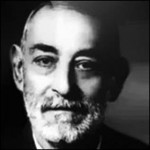
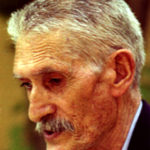
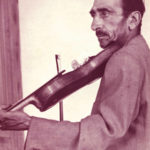
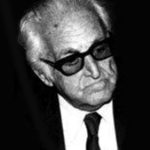
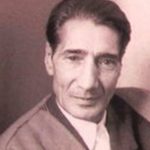
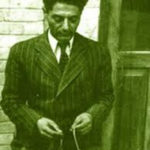
Rokneddin Mokhtari (1887–1970) was an Iranian musician and violinist. Mokhtari was born in Kermanshah. As well as being a musician, he was also the head of police department in Reza Shah era. He studied kamancheh with Hossein Esma`ilzadeh and befriended Darvish Khan. He had an exceptional gift for composing pishdaramads. Of his output one can name a Mahur Pishdaramad with metric variations, also pishdaramads in Homayun (to be sung later as a tasnif: “Asheqam man” by Moluk Zarrabi), Shur, Esfahan, Bayat-e Tork, Dashti, and Segah. A tasnif in Bayat-e tork on the lyrics of M. Bahar (“Gar raqib ayad”) is one of his famous pieces.

His compositional style was known as “rokni.” His reng in Homayun, his 3 pishdaramads in Dashti, Esfahan, and Chahargah have been published in the Method of Violin of Conservatoire, vols II-IV. During his administrative years, he often used to play violin and accompanying Vaziri who played tar in Amir Showkat-ol-Molk’s house.

Mousa Maroufi

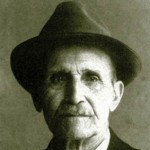
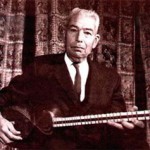
Moussa Maroufi ( 1889 – 1965) began studying the tar with Darvish Khan. He had a keen interest in learning the theory of music and studied music notation with Hossein Khan Hangafarin. When Alinaqi Vaziri founded his School of Music in 1924, Moussa Maroufi was one of the first students who joined the school.

He collaborated with Vaziri on many levels, and most of the music notation examples in Vaziri’s books were written by him. Alinaqi Vaziri had accumulated several notebooks containing the radifs by Mirza Abdollah and Aqa Hossein-Qoli. Moussa Maroufi had already learned Darvish Khan’s version of the radif, which was somewhat shorter than the radif played by the masters who preceded him.  Maroufi combined the radifs of Mirza Abdollah and Aqa Hossein-Qoli with that of Darvish Khan and other notes provided by Mehdiqoli Hedayat. The Ministry of Culture and Art published this valuable collection of the  radif of Persian classical music in 1963.

Moussa Maroufi was one of the first musicians who performed at Radio Iran. He worked closely with Rouhollah Khaleghi and was a member of the National Music Society Orchestra. He taught at the School of National Music from the very beginning of its founding and has trained many of the country’s finest musicians. Several of his works were included in the instrumental methods that were published by Khaleghi for the School of National  Music.

Abdollah Davami

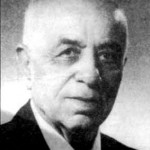
Abdollah (Khan) Davami (1891 – 1980) was a master musician and singer of traditional Iranian music.

He was a teacher of traditional music and had studied under Mirza Abdollah Farahani and Hossein Khan Esmailzadeh. Many famous Iranian singers were his student. He alongside Darvish Khan and others were the first to travel to Europe with the purpose of researching ways of preserving and developing classical music in Iran.

Hossein Gol-e-Golab

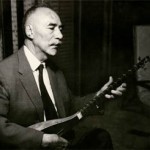
Hossein Gol-e-Golab  (1895 – 1985) was an Iranian scholar and musician who wrote the nationalist anthem “Ey Iran”.

Gol-e-Golab was born in Kerman. He learned to play both the setar and tar as a boy. He taught at Dar al-Fonun and later enrolled at the law school there, earning degrees in law and political science in 1922. However, he displayed a great talent for the natural sciences, especially botany, and in 1928 was tenured at the school of medicine. This later became the Faculty of Medicine at the emerging University of Tehran.Gol-e-Golab never lost his interest in music, finding time to translate Western operas into his native Persian while teaching and writing on botany and serving on the Academy of Persian Language and Literature, to which he was appointed in 1935. In 1944, after witnessing an ugly incident where an American soldier serving on the Persian Corridor beat up a native Iranian greengrocer, Gol-e-Golab composed the poem Ey Iran, which was set to music by Rouhollah Khaleghi and soon became a de facto Iranian national anthem.

Nour Ali Elahi

Nour Ali Elahi (1895 – 1974) was a Kurdish spiritual thinker, musician, philosopher and jurist.  His father, Hajj Nematollah (1871–1919), was a mystic poet who was a revered leader of a sufi group. From early childhood, he led an ascetic, secluded life of rigorous discipline under his father’s supervision with a special focus on mysticism, music, and ethics. He never performed in public and did not make any recordings of his music in a professional setting.

Elahi’s music is rooted in a tradition involving the rhythmic recital and invocation of sacred texts in devotional gatherings, accompanied by various instruments such as the tambour,  ney and daf. Elahi was a master of the tanbour. His musical ornamentations and complex playing technique, which for the first time involved the use of all five fingers of both hands, as well as his physical modifications to the instrument itself – namely, the doubling of the higher string so as to dramatically increase its expressiveness – earned him a reputation as an innovator of this art form and a master of the tanbour .

Sa’id Hormozi

Ostad Sa’id Hormozi (1897–1976) was born in one of the old neighborhoods of Tehran called Sangalaj. He was a great radif master and virtuoso tar and setar player. His most important teacher was Darvish Khan, who awarded Hormozi with the medal of the “Golden Hatchet”, which was given to his most prominent students.

In 1928 Hormozi founded a school of music in Tehran. Later he cooperated with the “Center for preservation and propagation of Persian music” as an ostad of setar. Some invaluable recordings have been preserved of him. In terms of performance techniques one can find traces of his ostad Darvish Khan in Hormozi’s style. His phrasing is mostly influenced by that of Aqa Hossein-Qoli.

Two of his most important students are ostad Mohammad Reza Lotfi and ostad Hossein Alizadeh.

Jane Lewisohn

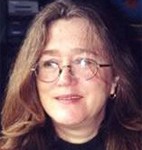
Jane Lewisohn has been a research fellow at the Institute of Arab and Islamic Studies of Exeter University and the music department of the School of Oriental and African Studies. She is a graduate of Shiraz University and fluent in Persian. Her latest works include a major undertaking in regards to the golha programme. She has done a great deal in making sure this valuable musical collection is preserved.

She has been involved with the Toos Foundation since early beginnings and has collaborated with a number of its events especially the Immortal Flowers which was devoted to the golha programme and its makers. She is currently on Toos Foundation’s academic advisory board.

Ali Akbar Shahnazi

Ali Akbar Shahnazi (1897 –1985) was an Iranian musician and master of the tar. His father, Mirza Hossein Gholi, the great master of tar named him Ali Akbar after his grandfather. Ali Akbar Khan Farahani, the great master of tar. He started learning tar from his father at the age of 7. After five years he reached a level that enabled hime to teach some of his father’s students. At the age of 18 after the demise of his father he was the responsible of his father’s class and started teaching them. Later, he established the Shahnazi Music School in 1929.

He recorded many pieces with the great vocalists of his time such as Eghbal Azar, Nakisa and so on. Also he has collaborated with other great master of his time such as Reza Mahjubi (violinist) and Hosain Tehrani (father of modern tonbak).

Reza Mahjubi

Reza Mahjubi (1898 – 1954) was an Iranian violinist and composer. Mahjubi’s first teacher was Hossein Hang Afarin, an army music officer. He was later taught by Ebrahim Ajang, but left these lessons after disagreeing with Ajang’s emphasis on musical theory over less formal learning. Instead, he trained with Hossein Khan Esmail Zade, a master player of kamancheh, from whom Mahjubi also learned to play the violin.

At 25 Mahjubi began to teach music classes; he continued composing new works and performing concerts at the same time. In 1923 he conducted some popular concerts with Darvish Khan and Aref Qazvini. Poet Amiri Firuzkuhi was among his close friends. Among Mahjubi’s most famous students were Roohollah Khaleghi and Majid Vafadar.

Morteza Neydavoud

Morteza Neydavoud (1900-1990), celebrated composer of music and performer and instructor of the tār was born to a Persian Jewish family in Isfahan during the Qajar times. His father Bala Khan played the tonbak, and Neydavoud taught himself to play the tar at an early age. Recognizing his son’s talent in music, the elder Neydavoud apprenticed the seven-year-old to Ramazan Khan Zolfaqari who was a student of the great master of the tar, Mirza Hosseingholi. After two years, Ramazan Khan took Morteza to his master  Mirza Hosseingholi.

In Hosseingholi’s school, Neydavoud practiced the radif of the traditional music of Persia. After Hosseingholi’s death, Neydavoud continued his musical education with his best student and successor, Darvish Khan. With Darvish Khan, Neydavoud completed the study of radif and proceeded to learn other musical forms, such as pishdaramad, zarbi (rhythmic pieces), and tasnif. Neydavoud became Darvish Khan’s best student.

Several years later, Neydavoud participated in concerts with his brothers, Mousa and Soleyman, and other notable musicians, such as Abolhassan Saba, Reza Mahjoubi, Morteza Mahjoubi, Arsalan Dargahi, Reza Ravanbakhsh, and Qamarolmolouk Vaziri. In addition to his concerts and recordings, Neydavoud established a school for music, which he named Darvish. In 1940 he was invited, along with a group of other well-known musicians, to join the staff of the Radio Iran. However, administration of the Radio Iran made it impossible for Neydavoud to maintain a free and productive career in the organization and he left it and became reclusive at the height of his creativity.

He continued his involvement with music only through a small circle of close friends, acquaintances, and private students. Neydavoud returned to the radio some thirty years later, when he finally accepted its invitation to record his version of the radif of Persian traditional music. Within a period of about one-and-a-half years, he meticulously recorded the radif as he remembered receiving it from his masters, resulting in a body of almost 300 audiocassettes.
Adib Khansari

Adib Khansari (1901 – 1982) was a vocalist.

He was a student of Nayeb Asadollah (The Ney player). He also traveled extensively in the Bakhtiari province to research the style of Lori Music in Iran. In 1924, he moved to Tehran to study under Hossein Taher Zadeh, and also Hossein Esmaeil Zadeh. He was invited in the 1940s to work on the National Radio and was one of the prominent artists in this organization. He, jointly with Esmaeil Mehrtash, founded the community of Barbad as a place for theatre and music.

Habib Samayi

Ostad Habib Samayi (1901-1947) was a virtuoso santur player.

His main teacher was his father Habib Sama Hozoor. He also attended a musical school run by Gholamhossein Minbashian. 10 years before Radio Tehran started, he had recorded few albums (with vocals from Parvaneh). He worked with Radio Tehran in its first 5 years. He was one of the founding members of the National Musical Association established in 1945.

He became disillusioned with performance music and stopped playing in public. After him, santur went through a period of decline in Iranian music until it was revived by Ostad Saba who was familiar with Samayi’s techniques and taught famous musicians such as Faramarz Payevar who helped to re-establish santur.