Monthly Archives: January 2012
Iranian Traditional Music
[wpcol_1half id=”” class=”” style=””]
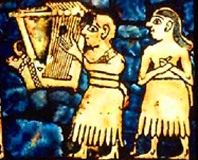
Hand held Harp – “Standard of Ur” – 3rd Millennium BC
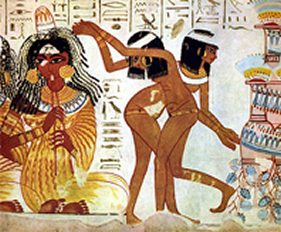
Double pipe, Thebes tomb, 1400 BC
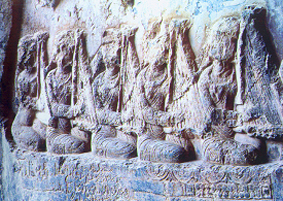
Women playing Chang (Harp) – 6th century Sassanid Iran
[/wpcol_1half] [wpcol_1half_end id=”” class=”” style=””]
Ancient Times
Music in Iran dates back to antiquity. Evidence of musical instruments, musical performances, singing and dancing, exist as far back as the Sumerian culture. The Elamites, centred in southwestern Iran must have carried over these musical traditions. Not much is known about that period. However, archeological evidence has revealed a number of Sumrian musical instruments that were used in Iran during the 2nd and 1st millennium BC.
Not much is known about the early Medes or Achaemenids periods either, except that music played an important role in state ceremonies, especially in religious affairs, during the Achaemenid rule. It is known that ancient Iranians had hymns which were collectively performed and that during the Achaemenids there were specially trained groups which performed these hymns. During the Parthian era, we know of the existence of groups of troubadours who were highly sought after as entertainers. The first evidence of poetry reading or singing performances accompanied by music comes from this period.
Music also played a very important role in the courts of Sassanid kings; and about its later stages we know a lot more. We know, for example, the names of various court musicians like Ramtin, Bamshad, Nakisa, Azad, Sarkash, and Barbod. We also know many of the instruments that were used like chang (harps), tanbur (lutes), ney (flutes), nayanban (bagpipes) and dayereh (drums).
Of these, Barbod (590 to 628 AD) was a highly significant court musician who developed the Persian modal system of music and modified many of the existing musical instruments and it is also said invented new ones. Indeed it is believed the word for the musical instrument Barbat (ancestor of Ouds) comes from an Arabicized version of his name. He was said to have been the inventor of the instrument. Today’s classical music tradition in Iran bears the same names of some of the modes of that era. It is, however, impossible to know if they sound the same because there is no evidence of musical notation from the Sassanid period. Barbod’s musical system consisted of 7 “modes” (known as the “khosrovani” system, named after King Khosro Parviz who commissioned the work), 30 derivative modes, “lahn” (tone), and 360 melodies named “dastan” (story). The numbers representing the number of days in a week, month and a year in the Zoroastrian calendar which was current during the Sassanid period.
Not much is known about Barbod’s musical theories on which the modal system was based, however, the writers of later periods have left a list of these modes and melodies. These names include some of epic forms such as kin-e Iraj (the Vengeance of Iraj), kin-e siavash (the Vengeance of Siavash), and Takht-e Ardeshir (the Throne of Ardeshir) and some connected with the Sassanid royal court such as Bagh-e shirin (the garden of Shirin), Bagh-e Shahryar (the Sovereign’s Garden), and haft Ganj (the seven treasures). There are also some of a contemplative or descriptive nature like roshan cheragh (bright lights). Barbod’s elaborate system indicates that he must have been the product of a rich musical tradition that went before him. His modal system is the oldest Middle Eastern musical system of which some traces still exist.
[/wpcol_1half_end]
Islamic Period
Not much is known about music in Iran immediately after the Sassanid period. The Islamic era more or less ended the developments in music which were progressing at a fast pace during the previous period. Musical performances were almost banned or drastically reduced (except for military marches) and musicology in general suffered a major blow during this period. Many of the Iranian musicians of the time emigrated abroad with some ending up in the Umayyad court, the cause of their demise! Whilst Arab appointed governors of Persian provinces were very strict in enforcing musical ban on the indigenous population, the Umayaads had court musicians. The historical irony is that whilst music suffered in Iran, many Iranian musicians played a major role in developing Arabic music
The first of these was Ibrahim Al-Mawsili (742–804) whose musical family had suffered so much in the hands of the Arab governor of Fars that escaped to Kufa. Ibrahim eventually ended up at the court of Harun al-Rashid in Basra. He is said to have composed over 900 Arabic songs with Persian music. He was imprisoned many times for drinking wine but because of his popularity survived every mishap and stayed at his position in the court until his death.
His son Ishaq Al-Mawsili (767-850) became a famous composer and teacher of music. He set up a musical school in Baghdad and was well received at the Abbasid Court. It is accepted that he has had a major role in Arabic musicology although not much is known about his own work. One of his students, Zaryab (789–857 ), Abu l-Hasan Ali Ibn Nafi, became very famous in Baghdad as a poet, singer and a gifted player of the Persian barbat.
Zaryab ended up in Cordoba, at the Islamic court in Iberia. He set up a musical school that trained singers and musicians (both male and female) which influenced musical performance for at least two generations after him. He modified the Persian barbat by adding a fifth pair of strings (oud) and introduced Cordoba’s musicians to many of the Persian instruments (mainly lutes) as well as passionate songs, tunes and dances from Persia. He was a great influence on Spanish music, and is considered the founder of the Andalusian style of music. The work he did was what led to flamenco music. His inventive work on the oud also led later to the development of the Guitar.
[wpcol_1half id=”” class=”” style=””]
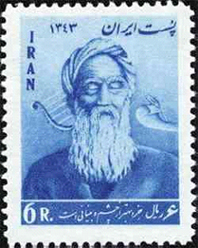
Rudaki depicted as a blind poet, Iranian stamp
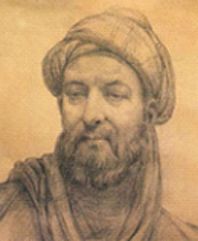
Ibn Sina
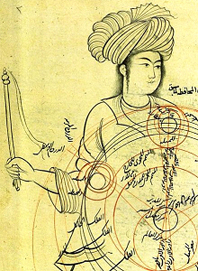
An epicyclic planetary model, from a medieval manuscript by Qotbeddin Shirazi
[/wpcol_1half] [wpcol_1half_end id=”” class=”” style=””]
During the 4th century AH, Farabi (872 – 951 AD), the Persian scientist and philosopher, who also played the barbat, wrote an important book on music, kitāb al-mūsīqī al-kabīr (“The Great Book Of Music”). Although in Arabic and taken by many Arab historians to be a book about Arabic music, it is in fact about Persian music. He presents philosophical principles about music, its cosmic qualities and its influences.
Al-Farabi’s treatise on Meanings of the Intellect also dealt with music therapy, where he discusses the therapeutic effects of music. The 9th century AD saw the beginning of the breakup of Caliphate rule in Iran. Gradually a number of semi-Persian or proto-Persian kingdoms begin to develop in the Iranian parts of the Islamic empire which start promoting Persian culture. Rudaki (858 – 941), a Persian poet at the Samanid court, called the “father of Persian poetry”, and the first important poet to return to farsi language was also a chang [harp] player. He wrote a number of treaties on Persian music which have been lost.
In his wake comes Ibn Sina (980– 1037), the great Persian Physician, expert in medicine, astronomy, mathematics, philosophy and many other subjects. He also discusses music in a number of his works.
Next is Naser Khosrow (1004 – 1088) a Persian poet, philosopher and scholar. The Safarname, an account of his travels, is one of his famous works. He was well versed in all the branches of natural science, in medicine, mathematics, astronomy and astrology, in Greek philosophy and the writings of al-Kindi, al-Farabi and Ibn Sina. He was also a musician and is said to have written extensively on the subject.
After the 11th century a number of important works on Persian musicology begin to appear. The first of these is by Safi al-Din al-Urmawi (1216 – 1294) who was a renowned musician, calligrapher and writer on the theory of music. He is perhaps best known for developing in the thirteenth century the widely used seventeen-tone scale later expanded by Arab musicians to the Arabic scale of twenty-four quarter tones.
His most important works are two books on music theory, the Kitab al-Adwār and Risālah al-Sharafiyyah fi ‘l-nisab al-taʾlifiyyah. The Kitab al-Adwār is the first extant work on scientific music theory after the writings on music of Avicenna. It contains valuable information on the practice and theory of music in the Perso-Iraqi area, such as the factual establishment of the five-stringed lute (still an exception in Avicenna’s time), the final stage in the division of the octave into 17 steps, the complete nomenclature and definition of the scales constituting the system of the twelve Maghams and the six Avāz modes. It also contains precise depictions of contemporary musical metres, and the use of letters and numbers for the notation of melodies. It is the first time that this occurs in history, making it a unique work of greatest value.
By its conciseness it became the most popular and influential book on music for centuries. No other Arabic, Persian or Ottoman Turkish music treatise was so often copied, commented upon and translated into other languages. The Kitab al-Adwār was conceived as a compendium (mukhtasar) of the standard musical knowledge of its time. Al-Urmawi was in contact with the Persian scholar Nasir al-Din Tusi (1201–1274) who also left a short treatise on the proportions of musical intervals.
The next contribution came from Qotb al-Din Shirazi (1236 – 1311), a Persian poet and a Rebab player who in addition to music has made important contribution to astronomy, mathematics and medicine. He was also a Sufi thinker and wrote an important treatise on Sohrevardi’s philosophy.
The Persian poet Amir Khosro (1253-1325) is largely known for his Persian poetry but he was probably one of the most important influences on North Indian Classical Music. His writings on the Pardah system of music are a foundation stone of classical Indian music and probably explains the similarities that exist between North Indian and Iranian music. It is said he either invented the Indian Sitar or his Pardah system led directly to its invention. Sitar can make unlimited Pardah system by placing the 12-13 plectrums in various positions, thus exposing numerous potentialities.
[/wpcol_1half_end]
Then comes Abd al-Qadir al-Maraghi (middle of 14th – 1435), a Persian musician and artist. Who was according to the Encyclopedia of Islam, “the greatest of the Persian writers on music“. He is known for his four works on music theory. The three surviving works are written in Persian. His most important treatise on music is the Jame’al-Alhan (Encyclopedia of Music), first written in 1405. He compiled a second edition of this work a decade later. The second major work of Abd al-Qadir is Maqasid al-Alhan (Purports of Music). The third, the Kanz al-Tu.af (Treasury of Music) which contained the author’s notated compositions, has not survived. He has also written treaties on Chinese music. He wrote songs in Persian, Arabic, Turkish and Mongolian.
Jame’al-Alhan, without any doubt is the only extant document to contain appreciable information about the modal structure of Iranian music in the pre-dastgah system. However, the definition of musical categories, the intervals of Maqam-s and their cycles, the tunning systems, the instrumentation and organological classification, and the rhythms are included in this very valuable text. For the definition of musical terms, he respectfully refers to Farabi, Ibn Sina and Safiedin Ormavi.
[wpcol_1half id=”” class=”” style=””]
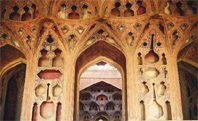
A music chamber inside Aali Ghaapoo mansion in Isfahan – 17th century
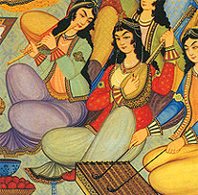
From Hasht Behesht Palace Isfahan, 17th century
[/wpcol_1half] [wpcol_1half_end id=”” class=”” style=””]
Recent History
Today’s formal, classical music tradition is directly linked to the music systems developed during the Safavid period (1501 – 1722). They were modified and restructured during the Qajar period into the current classical system.
Āghā Ali-Akbar Farāhāni was a renowned musician at Nasir Al-Din Shah’s court and a virtuoso tar and setar player. He is the father of two significant Iranian musicians, Mirza Abdollah and Mirza Hossein Gholi, and the paternal grandfather of another outstanding musician, Ahmad Ebadi, Mirza Abdollah’s son.
Iranian classical music relies on improvisation. Composition is based on a series of modal scales and tunes. The repertoire consists of more than two hundred short melodic movements called gusheh, which are classified into seven dastgāh (modes). Two of these modes have secondary modes branching from them called āvāz. Each gusheh and dastgah have an individual name. This whole body is called the Radif (repertoire) of which there are several versions, each in accordance to the teachings of a particular ostad (master).
Apprentices and masters, ostad, have a traditional relationship which has declined during the 20th century as music education moved to universities and conservatories. A typical performance consists of the following elements pīshdarāmad(a rhythmic prelude which sets the mood), darāmad (rhythmic free motif), āvāz (improvised rhythmic-free singing), taṣnīf (rhythmic accompanied by singing, an ode), Chahārmeżrāb (rhythmic music but rhythmic-free or no singing), reng (closing rhythmic composition, a dance tune). A performance forms a sort of suite. Unconventionally, these parts may be varied or omitted.
[/wpcol_1half_end]
Towards the end of the Safavid Empire (1502-1736), more complex movements in 10, 14, and 16 beats stopped being performed. In fact, in the early stages of the Qajar Dynasty, the uṣūl (rhythmic cycles) were replaced by a meter based on the ghazal and the maqām system of classification was reconstructed into the Radif system which is used to this day. Today, rhythmic pieces are performed in beats of 2 to 7 with some exceptions. Rengs are always in a 6/8 time frame. Many melodies and modes are related to the maqāmāt of the Turkish classical repertoire and Arabic music belonging to various Arab countries, for example Iraq. This similarity is because of the exchange of musical science that took place in the early Islamic world between Persia and her neighboring countries. During the meeting of The Inter-governmental Committee for the Safeguarding of the Intangible Heritage of the United Nations, held between 28 September – 2 October 2009 in Abu Dhabi, radifs were officially registered on the UNESCO List of the Intangible Cultural Heritage of Humanity.
The classical music is vocal based. The vocalist plays a crucial role: she or he decides what mood to express and which dastgah relates to that mood. In many cases, the vocalist is also responsible for choosing the poems to be sung. If the performance requires a singer, the singer is accompanied by at least one wind or string instrument, and at least one type of percussion. There could be an ensemble of instruments, though the primary vocalist must maintain hers or his role. In some taṣnīf songs, the musicians may accompany the singer by singing along several verses. Traditionally, music is performed while seated on finely decorated cushions and rugs. Candles are sometimes lit. The group of musicians and the vocalist decide on which dastgahs and which of their gushehs to perform, depending on the mood of a certain time or situation.
Iranian classical music continues to function as a spiritual tool as it has throughout its history, and much less of a recreational activity. Compositions can vary immensely from start to finish, usually alternating between low, contemplative pieces and athletic displays of musicianship called tahrir. The incorporation of religious texts as lyrics were replaced by lyrics largely written by medieval Sufi poets, especially ghazals of Hafez and Shamsa.
[wpcol_3quarter id=”” class=”” style=””]
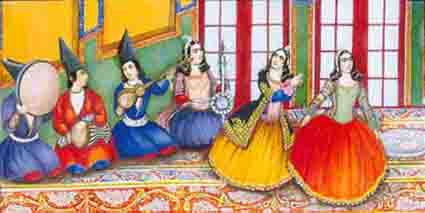
A group of musiciand from the Ghajar period
[/wpcol_3quarter] [wpcol_1quarter_end id=”” class=”” style=””]The Radif:
Dastgah-e Shur (considered the mother of all dastgahs)
Avaz-e Abu’ata
Avaz-e Bayat-e Tork
Avaz-e Afshari
Avaz-e Dashti
Dastgah-e Homayoun
Avaz-e Bayat-e Esfahan
Dastgah-e Segah
Dastgah-e Chahargah
Dastgah-e Rastpanjgah
Dastgah-e Mahur
Dastgah-e Nava [/wpcol_1quarter_end]
Shiva Shafighian
Mahmoud Khoshnam
BBC Farsi report – The Iranian Opera Night: Dr. Mahmood Khoshnam (Lecturer), Pooyan Azadeh (Piano Solo), Pari Samar, Armin Mahfam and Afsane Sadeghi (Singers) >>>
Dr Raja Kamal
Dr Raja Kamal – Economics and Educations in the Fight Against Cancer >>>
Professor Susan Mayer
Professor Colm O’Muircheartaigh
Baroness Caroline Cox of Queensbury
Jamil Kharrazi
Toos Foundation-Jamil Kharrazi’s Speech at SOAS (Persian) >>>
From a poetry recital 2010 – Music by Homayoun Khosravi >>>
Jamil Kharrazi Interviews Hooshang Seyhoon (Prsian) >>>
Jamil Kharrazi Interviews Shojaeddin Shafa (Prsian) >>>
Jamil Kharrazi Interviews Pari Abasalti (Prsian) >>>
Jamil Kharrazi Interviews Farhang Farahi (Prsian) >>>
Jamil Kharrazi Interviews Reza Badei (Prsian) >>>
Jamil Kharrazi Interviews Abbas Pahlevan (Prsian) >>>
Jamil Kharrazi Interviews Jimmy Delshad (Prsian) >>>
Jamil Kharrazi Interview with Hadi Nilli, about the American University at Afghanistan (Prsian) >>>
Shiva Shafighian
Mahmoud Khoshnam
Dr Raja Kamal
Professor Susan Mayer
Professor Colm O’Muircheartaigh
Baroness Caroline Cox of Queensbury
Jamil Kharrazi
Personal Site >>>
Weblogs >>>
Lady Kharrazi at Park University >>>
Lady Kharrazi at US Command Centre General College >>>
Lady Kharrazi at the annual gala of Los Angele Ballet >>>
Ferdowsi Emrooz, No 439, Celebrities, Lady Kharrazi in Kansas City >>>
Javanan, No 1645, Kansas City Mayor Presents Lady Kharrazi with the key to the City >>>
Lady Kharrazi Is Presented with the key to Kanas City >>>
Jamil Kharrazi in Washington to Support American University in Afghanistan >>>
Jamil Kharrazi attends Global Hope Leadership Summit >>>
UNESCO Global Hope Coalition Honoring Empowering Women >>>
Salarzanan Iran Book, by Mansureh Pirnia, 2016, p372 >>>
The Harvard Committee >>>
The Harris School’d Deans International Council >>>
Buck Institute Advisory Council Memebers >>>
National University of Singapore’s International Council >>>
Iran Dance Association: Trustees >>>
Harris School Profile >>>
Shirin Ebadi Speech >>>
Woman and Democracy in the Middle East >>>
Datebook on Jamil Kharrazi Foundation >>>
The Daily Star – 2000 – Kharrazi and Ghorayeb on a new Harvard Fellowship >>>
Alwasat (Arabic) – Kharrazi-Jackson Foundations – 1998 >>>
Hello, May 1998 – Cocktails for Jackie Jackson >>>
Hello, July 1998 – Lifeline Children’s Party >>>
Hello, Oct 1998 – Haven Trust Dinner and Concert >>>
JK speech at common wealth Hall London 1998 >>>
JK speech at the event honouring Robert De Warren South Lake City USA 2009 >>>
JK speech at the event honouring Jalal Zolfonoun at Royal Festival Hall 2010 >>>
Memberships
Member of Dean’s Council, John F. Kennedy School of Government, Harvard University
Member of International Dean’s Council of Harris School, University of Chicago.
Member of International Dean’s council’s of University of Singapore
Member of the Advisory Council of The Buck Institute for Research on Aging (Novato, CA)
Sponsorships & Affiliations
Sponsor of the New Philharmonic Orchestra of London
Sponsor of Iran Dance Association
Sponsor of Artists Without Frontiers
Sponsor of the London Cultural Art Centre
Sponsor of Eastern Artists, USA
Sponsor of the humanitarian organisation of Juzourouna
Sponsor of post-graduate students from Africa and Asia
Founder of London School of Music
A Celebration of Lobat Vala
100 Years of Popular Music in Iran
History of 3000 Years of Dance in Iran
The Immortal Flowers
The Golha Project >>>
History of Classical Music in Iran
Poetry, Dance and Lyrics in the Land of Harp and Mandolins
A Celebration of Lobat Vala
Radio Kian – Naser Amini onToos Foundation’s Event: A Celebration of Lobat Vala >>>
100 Years of Popular Music in Iran
History of 3000 Years of Dance in Iran
TV Iran Farda – about Toos Foundation Events >>>
TV Tasvir Iran – Nasser Engheta interviews Jamil Kharrazi >>>
TV Tasvir Iran – Toraj Neghaban interviews Jamil Kharrazi >>>
TV Tasvir Iran – Masoud Assadollahi on Toos Foundation >>>
TV Tasvir Iran – Farhang Farahi Interviews Jamil Kharrazi 2>>>
TV Ziafat – Interview with Jamil Kharrazi >>>
The Immortal Flowers
TV Tasvir Iran – Masoud Assadollahi interviews Jamil Kharrazi and Jane Lewishon >>>
TV Tasvir Iran – Farhang Farahi interviews Jamil Kharrazi and Jane Lewishon >>>
Pars TV – Alireza Meybodi interviews Jamil Kharrazi >>>
Pars TV – Masoud Sadr interviews Jamil Kharrazi >>>
Radio Deuche Welle – Elahe Khoshnam interviews Jamil Kharrzi >>>
History of Classical Music in Iran
TV Iran Farda – about Toos Foundation Events >>>
Pars TV – Parviz Ghazisaeed interviews Jamil Kharrazi >>>
Pars TV – Alireza Meybodi interviews Jamil Kharrazi >>>
TV Andisheh – Ziafat Program – Homayoon Khosravi with Jamil Kharrazi >>>
TV Andisheh – Ziafat Program – Interview with Jamil Kharrazi >>>
Poetry, Dance and Lyrics in the Land of Harp and Mandolins
TV Iran Farda – about Toos Foundation Events >>>
Pars TV – Farhang Farahi interviews Jamil Kharazi >>>
Channel 1 – Ardavan Mofid interviews Jamil Kharrazi >>>
Pars TV – Parviz Ghazisaeed interviews Jamileh Kharrazi >>>
Andishe TV – Homayoun Khosravi interviews Jamil Kharrazi >>>
Poetry Reading by Jamil Kharrazi with music from Homayoun Khosravi >>>
Andishe TV – Ziafat – interview with Jamil Kharrazi >>>
A Celebration of Lo’bat Vala
100 Years of Popular Music in Iran
The History of 100 years of Hits in Iran 1
Persian Weekly’s report on 100 years of Hits in Iran 1 2 3
Nimrooz’s report on 100 years of Hits in Iran 1
Tehran Magazine’s report on 100 years of Hits in Iran 1 2 3
Rah-e Zendegi Magazine’s report on 100 years of Hits in Iran 1
Javanan Magazine’s report on 100 years of Hits in Iran 1 2 3
Nubahar’s report on 100 years of Hits in Iran 1
Keyhan’s report on 100 years of Hits in Iran 1 2
History of 3000 Years of Dance in Iran
The Immortal Flowers
Rangarang’s report on the Gulha program 1 2 3
Keyhan’s report on the Gulha program 1 2 3 4 5 6 7
Nimrooz’s report on the Gulha program 1 2 3 4 5 6
Rooz online’s report on the Gulha program 1
Persian Weekly’s report on the Gulha program 1 2
Etela’at’s report on the Gulha program 1
Kaweh Periodical’s report on the Gulha program 1
History of Classical Music in Iran
Radio Zamaneh report on History of Classical Music in Iran 1
Persian Weekly’s report on History of Classical Music in Iran 1
Keyhan report on History of Classical Music in Iran 1234
Javanan Magazine’s report on History of Classical Music in Iran 12
Rangarang Report on Classical Music in Iran 1 2
Rah-e Zendegi Magazine’s report on Classical Music in Iran 1 2
Poetry, Dance and Lyrics in the Land of Harp and Mandolins
Bayazid Bastami
Bayazid Bastami (804-874), also known as Abu Yazid Bistami or Tayfur Abu Yazid al-Bustami, was a Persian Sufi poet born in Bastam. Bayazid’s grandfather was a Zoroastrian who converted to Islam. His grandfather had three sons, Adam, Tayfur and ‘Ali. All of them were ascetics. Abayazid was born to Tayfur. Not much is known of his childhood, but Bayazid spent most of his time in isolation in his house and the mosque.
Bayazid led a life of asceticism and renounced all worldly pleasures in order to be one with the Absolute. Bayazid became known as the first “intoxicated” Sufi. According to his peers he was both a devout moslem and a dangerous heretic. His belief in the ancient Persian idea of “unity of existence” angered the Islamic clerics in his town: “Whoever dissolves himself in God and grasps the truth he himself becomes the truth as he will become the representative of God in himself and thus finds himself within himself.” Or, “Moses desired to see God; I do not desire to see God; he desires to see me”.
Bayazid is regarded as one of the most influential mystics poets and a leading teacher of Sufism in post-Islamic Iran. Nothing has survived from his written work but references to him and his work exist in many later writings. Sufi poets such as Attar and Shams considered him a great teacher. Mohammad Ghazali (1058-1111), one of the most famous Sufi thinkers, also refers repeatedly to his debt to Bastami. The tomb of Bayazid is in Bastam near Shahroud.
Rudaki
Abu Abdollah Jafar ibn Mohammad Rudaki (858 – 941), was a Persian poet, and the first great literary genius of the Modern Persian, who composed poems in the “new” post-Islamic Persian language. Rudaki is thus considered as the founder of Persian classical literature. He is also said to have been the founder of the divan form (the typical form of the complete collection of a poet’s lyrical compositions in an alphabetical order of the rhymes, which all Persian poets use even today.
He was born in Rudak (Panjrud), a village located in Panjakent, Tajikistan. Even though most of his biographers assert that he was completely blind, some early biographers are silent about this or do not mention him as being born blind. His accurate knowledge and description of colors, as evident in his poetry, renders this assertion very doubtful.
He was the court poet to the Samanid ruler Nasr II (914–943) in Bokhara, although he eventually fell out of favour with the court after a reaction against the Ismaili sect to which it is said Rudaki belonged. Rudaki was imprisoned and tortured. Rudaki went back home where he was born and died shortly after that in poverty. He was buried there.
Mansur Hallaj
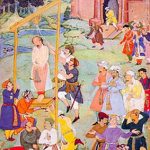
Mansur Hallaj, full name Abū al-Mughīth Husayn Mansūr al-Hallāj (858 – 922) was a Persian mystic, revolutionary writer and pious teacher of Sufism most famous for his self-proclaimed divinity, his poetry and for his execution for heresy at the orders of the Abbasid Calipha.
He was born in Toor in the Fars Province, was from a recently converted moslem family, and a Reader of the Quran. He learnt about Sufism in his youth and joined the movement. He was in contact with many of the protest movements of his time, especially Gharmatian (a radical wing of the Ismaili movement). They were mostly Iranians with Mazdaki ideas. He became a friend to Zakaria Razi the famous scientist and secular philosopher of the time and under his influence dropped out of Sufism.
Many consider him as the first Iranian thinker who set the foundations for fighting theocracy in post-Islamic Iran. His alleged crime of saying “ana al hagh” (“God is me”) was nothing more than the ancient Persian belief that god is in all of us. He was brutally executed in Baghdad after a long trial. Many later Iranian poets have devoted poems to him. Hafez says of him aprovingly: “That friend whose head made the gallows grow, his crime was making secrets glow!“
Abu-Mansur Daghighi
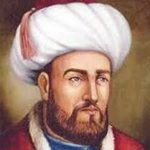
Abu Mansur Muhammad Ibn Ahmad Daqiqi Tusi (935/942 – 976/980), was an early Persian poet from Tus in Iran. He was a Zoroastrian convert to Islam and a court poet to Nuh II of the Samanid dynasty.
Daqiqi was a representative of the shu’ubiyah movement, which expressed the striving for independence from the Islamic caliphate by means of the glorification of native traditions and customs. He attempted to write in Persian an epic history of Iran which begun by the history of Zarathushtra and Gashtasb. He thus wrote the first versified version of the Shahnameh in New Persian. He was assassinated before he could finish it.
Only a few fragments of Daqiqi’s lyric verse remain. A large number of couplets by him (probably about a 1000 lines) were included in the epic Shahname (Book of Kings) by the Persian epic poet Ferdosi. Some scholars speculate that he wrote more, but the content was too controversial to be included in Shahname and later lost. Daqiqi’s poetry is distinguished by its picturesque quality and abundance of metaphors.
Shahid Balkhi
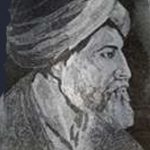
Abul Hasan Shahid ibn Hussain Jahudanaki Balkhi also known as Shahid Balkhi (died 935 AD) was a Persian theologian, philosopher, poet and sufi. He was a close student of the famous Persian poet Rudaki who wrote a touching elegy on the death of his favourite student. He was born in Balkh and was contemporary to Ahmed ibn Sahl al-Balkhi. He also had contacts with Zakaria Razi, the well-known Persian polymath. He wrote poems both in Persian and Arabic languages. It is also known that he was a great calligrapher.
He was living in the Samanid era so he spent most of his life in the court of Samanids and has eulogised king Nasr Ibn Ahmad Samani and his minister “Abu Abdullah Jeyhani” in his poems. Although more a Sufi than a poet, he was one of the first poets to write in Persian in the Islamic era and like Rudaki was well recieved by other poets. Rudaki, Daghighi, Manuchehri, Khaghani and Farrokhi Sistani have all written about him.
He died in Balkh, Khorasan. Only about a 100 lines of his poetry has survived.
Ferdowsi
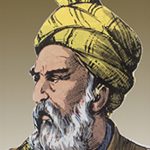
Hakim Abolghasem Firdos Tusi more commonly transliterated as Ferdosi or Ferdowsi (940–1020) is a highly revered Persian poet. He is best known for his literary epic Shahnamehe, the national epic of Iran and related societies. Ferdosi devoted most of his life to witing it. Shahnameh was originally drafted for the Samanid rulers who were responsible for the revival of the Persian cultural traditions after the Arab invasion. Ferdosi would live to see the Samanids conquered by the Ghaznavids. The new ruler Mahmud of Ghaznavi would lack the same interest in Ferdosi’s work as that shown by the Samanids, resulting in him losing favor with the royal court. Ferdosi died in 1020 in poverty though confident that the work that he had created would last the test of time.
Written at the end of the 10th century, Shahnameh is concerned with pre-Islamic Iran, through its fictional protagonist, Rostam, a Persian hero and legend who is a greater-than-life figure (akin to Hercules) living for more than five hundred years, undergoing seven trials of strength, battling foes of man, beast, and dragon, and serving more than five Persian monarchies. Ferdosi’s Rostam is an epitome of bravery, heroism, and loyalty to the Persian throne. Rostam however is more than just a legend and a hero, in that he is constantly on the edge, and always resolute to assert that he is “his own man” able to define his own destiny and make his own choices, regardless of needs of others even those of the kings he so faithfully serves.
Farrokhi Sistani
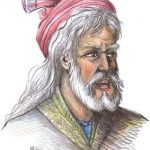
Abul Hasan Ali ibn Julugh Farrukhi Sistani (died 1037) was a royal poet of Ghaznavids. As an ethnic Persian, he was one of the brightest masters of the panegyric school of poetry in the court of Mahmud of Ghazni.
He started his career by writing a ghasideh called ‘With a Caravan of Fine Robes’ and presented it to Asa’ad Chaghani, the vizier of Saffarid king of Sistan. This poem was so beautiful and masterful that Farrokhi was admitted to the court. The next day when the king went to his ranch to brand his new young horses, the vizier described to Farrukhi the setting of branding of horses. Farrokhi went home and based on the descriptions and without seeing the actual scene, wrote a new poem called ‘Branding Place’. The next morning he went back to the vizier and recited the poem. Vizier was so impressed that immediately took Farrokhi to the king. When this poem was recited to the king, he was so impressed that he gave 40 young horses to Farrokhi as gift.
Farrokhi was also a master in music and could play barbat and had a nice voice and could sing too. He later moved to the court of Ghaznavids, first Mahmud and then his son, Masud. Farrokhi’s divan of 9000 verses survived.
Abu Saeed AbolKheyr
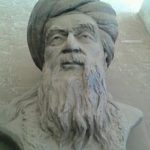
Abu Saeed Abolkheyr or Abū-Sa’īd Abul-Khayr (967 – 1049), was a famous Persian Sufi who contributed extensively to the evolution of Sufi tradition. The majority of what is known from his life comes from the book Asrar al-Tohid written by Mohammad Ibn Monavvar, one of his grandsons, 130 years after his death. The book, which is an important early Sufi writing in Persian, presents a record of his life in the form of anecdotes and contains a collection of his words.
During his life his fame spread throughout the Islamic world, even to Spain. He was the first Sufi writer to widely use ordinary love poems as a way of expressing and illuminating mysticism, and as such he played a major role in the formation of Persian Sufi poetry. Also at his time the Islamic legitimacy of Sufi dance was a matter of debate among the scholars and some clerics attempted to try him and his followers on charges of un-Islamic innovations, dancing and use of poetry in public sermons, but they failed to do so because of his popularity.
Abū-Sa’īd and Ibn Sina, the Persian physician and philosopher, corresponded with one another. The first meeting is described as three days of private conversation, at the end of which Abū-Sa’īd said to his followers that everything that he could see, Ibn Sina knew, and in turn Avicenna said that everything he knew Abū-Sa’īd could see.
Rabeeh Balkhi
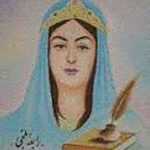
Rābi’a bint Ka’b al-Quzdārī, popularly known as Rabe’eh Balkhī, is a semi-legendary figure of Persian literature and was possibly the first poetess in the history of New Persian poetry. References to her can be found in the poetry of Rudaki and Attar. The longest narration of Rabia’s life and poetry is in the poem of the Elāhi-nāma (Book of the Divine) by the 12th-century Sufi poet, Farid al-Din ʿAttār.
Her biography has been primarily recorded by Zāhir ud-Dīn ‘Awfī and renarrated by Nūr ad-Dīn Djāmī. The exact dates of her birth and death are unknown, but it is reported that she was a native of Balkh in Khorāsān (now in Afghanistan). Some evidence indicates that she lived during the same period as Rūdakī, the court poet to the Samanid Emir Naṣr II (914-943).
She is said to have been descended from a royal family, her father Ka’b al-Quzdārī, a chieftain at the Samanid court, reportedly descended from Arab immigrants who had settled in eastern Persia during the time of Abu Muslim. She was one of the first poets who wrote in modern Persian, and she is, along with Mahsatī Ganjavi, among the very few female writers of medieval Persia to be recorded in history by name.
Manuchehri Damghani
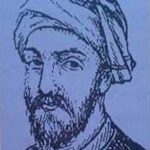
Abu Najm Ahmad ibn Ahmad ibn Qaus Manuchehri aka Manuchehri Damghani, was a royal poet of the 11th century in Persia. He was from Damghan in Iran and he is said to be the first to use the form of “musammat” in Persian poetry and has the best ones too. He traveled to Tabarestan and was admitted to the court of King Manuchehr Ghabus of Ziyarid dynasty and that’s where he got his pen name.
After the death of Manucher Ghabus he went to Rey and from there he found his way to the court of Ghaznavids. He became a royal poet in the court of Sultan Shihab ud-Dawlah Mas’ud I of Ghaznavi son of Mahmud of Ghaznavi.
His poetry was mostly about nature. He also knew Arabic and is said to have had extensive knowledge of astronomy and music too. In his poetry references to these subkects are abundant. He has left behind a divan. He died in 1040 AD. His works were extensively studied by A. de Biberstein-Kazimirski in 1886.
Naser Khosro
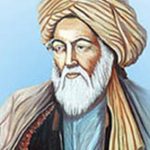
Abu Mo’in Hamid ad-Din Nasir ibn Khusraw al-Qubadiani or Naser Khosro (1004 – 1088) was a Persian poet, philosopher, Islamic scholar and traveler. He is one of the great poets and writers in Persian literature. Safarname, an account of his travels, being his most famous work possesses a special value among books of travel, since it contains the most authentic account of the state of the Muslim world in the middle of the 11th century. He was well versed in all the branches of natural science, in medicine, mathematics, astronomy and astrology, in Greek philosophy and the writings of al-Kindi, al-Farabi and Ibn Sina; and the interpretation of the Qur’an. He had studied Arabic, Turkish, Greek, the vernacular languages of India and Sindh, and perhaps even Hebrew.
At Cairo, he became thoroughly imbued with the Shi’a Isma’ili doctrines of the Fatimids, and their introduction into his native country was henceforth the sole object of his life. He was raised to the position of dā‘ī “missionary” and appointed as the Hujjat-i Khorasan, though the hostility he encountered in the propagation of these new religious ideas after his return to Greater Khorasan in 1052 and Sunnite fanaticism compelled him at last to flee. After many wanderings he found refuge in Yamgan (about 1060) in the mountains of Badakhshan, where he spent as a hermit the last decades of his life, and gathered round him a considerable number of devoted adherents, who handed down his doctrines to succeeding generations.
Baba Taher
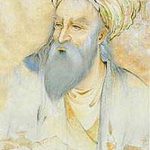
Baba Taher (Baba Taher Oryan) was an 11th century poet in Persian literature and a mystic thinker. Baba Tahir is known as one of the most revered and respectable early poets in Iranian literature. Most of his life is clouded in mystery. He was born and lived in Hamadan and was known by the name of Baba Taher-e Oryan (The Naked), which suggests that he may have been a wandering dervish. Legend tells that the poet, an illiterate woodcutter, attended lectures at a religious school, where he was not welcomed by his fellow-students. The dates of his birth and death are unknown. One source indicates that he died in 1019. If this is accurate, it would make Baba Taher a contemporary of Ferdosi and Ibn Sina (Avicenna) and an immediate precursor of Omar Khayyam.
Baba Tahir poems are recited to the present day all over Iran. Baba Tahir’s poems are of the do-bayti style, a form of Persian quatrains, which some scholars regard as having affinities with Middle Persian verses. Classical Persian Music is based on Persian literature and Baba Tahir’s poems are the weight that carries a major portion of this music. Baba Tahir’s poetry is the basis for Dastgahe Shoor and in particular the Gooshe s of Dashtestani, Choopani and Deylaman. Attributed to him is also a work by the name Kalemat-e qesaar (catch phrases), a collection of nearly 400 aphorisms in Arabic,
His tomb, designed by Mohsen Foroughi, is located near the northern entrance of the city of Hamadan in Western Iran.
Ghatran Tabrizi
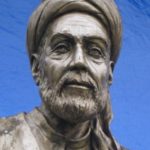
Abū-Mansūr Qatrān-i Tabrīzī (1009–1072), was a royal Persian poet. He was born in Sahar near Tabriz and was the most famous panegyrist of his time in Iran. He would identify his ancestry from Gilan and from the Dehqan class. His work has aroused the interest of historians, for in many cases Qatran has perpetuated the names of members of regional dynasties in Azerbayjan and the Caucasus region that would have otherwise fallen in oblivion.
Qatran’s poetry follows in the wake of the poets of Khorasan and makes an unforced use of the rhetorical embellishment. He is one of the first poets after Farrokhi to try his hand at the Ghasidehi (ode) form. Qatran’s ghasidehs on the earthquake of Tabriz in 1042 has been much praised and is regarded as a true masterpiece .
In his Persian divan of 3000 to 10000 couplets, Qatran praises some 30 patrons. He is not to be confused with another Persian author: Qatran of Tirmidh, who wrote the Qaus-nama one hundred years later.
Khajeh Abdollah Ansari
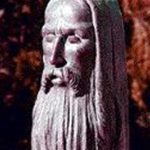
Abu Ismaïl Abdullah ibn Abi-Mansour Mohammad or Khajeh Abdollah Ansari of Herat (1006–1088), also known as Pir-e Herat (sage of Herat) was a famous Persian Sufi who lived in the 11th century in Herat. One of the outstanding figures in Khorasan in the 11th century: a commentator of the Ghoran, traditionalist, polemicist, and spiritual master, known for his oratory and poetic talents in both Arabic and Persian.
He practiced the Hanbali fiqh, one of the four Sunni schools of law or jurisprudence. His shrine, built during the Timurid Dynasty, is a popular pilgrimage site.
He wrote several books on Islamic mysticism and philosophy in Persian and Arabic. His most famous work is “Munajat Namah” (literally ‘Litanies or dialogues with God’), which is considered a masterpiece of Persian literature. After his death, his students and disciples compiled his teachings about the Tafsir of Quran, and named it “Kashful Asrar”. This is the best and lengthiest Sufi Tafsir of Quran, being published several times in 10 volumes.
Masud Sa’d Salman
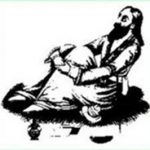
Mas’ud-i Sa’d-i Salmān was an 11th century Persian poet of the Ghaznavid empire who is known as the prisoner poet. He was born in 1046 in Lahore to wealthy parents from Hamadan, and his father Sa’d bin Salman was a great Persian ambassador who was sent to India by the Ghaznavids. Masud was born there and he was highly learned in astrology, calligraphy, and Persian and Arabic literature (he also knew the Indian languages).
In 1085, he was thrown into prison. He was released in 1096, when he returned to Lahore continued political changes resulted in another prison stay of 8 years. Most of his best poems were written in prison. He is therefore also known as the prison poet. His poems are beautiful and melancholic. Most of his works are written in the ghasideh form but he also has many quatrians. During one of his prison stays, he wrote the Tristia, a celebrated work of Persian poetry. He was in touch with some of the Persian Poets of the time, including Sanaii.
Sanai
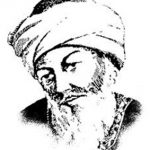
Hakim Abul-Majd Majdūd ibn Ādam Sanā’ī Ghaznavi was a Persian Sufi poet who lived in Ghazna, in what is now Afghanistan during the 11/12th century. He was connected with the court of the Ghaznavid Bahram-shah who ruled 1118-1152. It is said that once when accompanying Bahramshah on a military expedition to India, Sanai met the Sufi teacher Lai-khur. Sanai quit Bahramshah’s service as a court poet even though he was promised wealth and the king’s daughter in marriage if he remained.
He wrote an enormous quantity of mystical verse, of which The Walled Garden of Truth or The Hadiqat al Haqiqa is his master work and the first Persian mystical epic of Sufism. Dedicated to Bahram Shah, the work expresses the poet’s ideas on God, love, philosophy and reason. Sanai taught that lust, greed and emotional excitement stood between humankind and divine knowledge. Love and a social conscience are for him the foundation of religion; mankind is asleep, living in a desolate world. To Sanai common religion was only habit and ritual. For close to 900 years. Sanai’s poetry had a tremendous influence upon Persian literature. He is considered the first poet to use the qhasidah (ode), ghazal (lyric), and the masnavi (rhymed couplet) to express the philosophical, mystical and ethical ideas of Sufism. Rumi acknowledged Sanai and Attar as his two primary inspirations, saying, “Attar is the soul and Sanai its two eyes, I came after Sanai and Attar.”
Khayyam
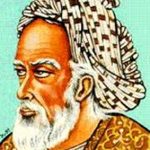
Omar Khayyám (1048–1131) was a Persian mathematician, astronomer, philosopher and poet. He also wrote treatises on mechanics, geography, and music. Born in Nishapur, at a young age he moved to Samarkand and obtained his education there, afterwards he moved to Bukhara and became established as one of the major mathematicians and astronomers of the medieval period. He is the author of one of the most important treatises on algebra credited with a geometric method for solving cubic equations. He also contributed to a reform of the Persian calendar.
His significance as a philosopher and teacher, and his few remaining philosophical works, have not received the same attention as his scientific and poetic writings. Many sources have testified that he taught for decades the philosophy of Ibn Sina in Nishapur. He is buried there.
Outside Iran and Persian speaking countries, Khayyám has had a major impact through the translation of his quatrains (rubaiyat) and popularization by other scholars. The most influential of all was Edward FitzGerald (1809–83) who made Khayyám the most famous poet of the East in the West through his celebrated translation of Rubáiyát of Omar Khayyám.
Mahsati Ganjavi
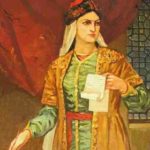
Mahsati Ganjavi (1089 – 1159) was a 12th century Persian poet. As an eminent poet, she was composer of quatrains (ruba’is). Originated from Ganja (Azarbayejan), she was said to have associated with both Omar Khayyam and Nezami.
She was a poet laureate to the courts of Sultan Muhammad I (1118-1131) and his uncle Sultan Sanjar (1131-1157). Her alleged free way of living and her verses have stamped her as a Persian Madame Sans-Gêne. Her purported love affairs are recounted in the works of Jauhari of Bukhara.
No details about her life are documented except that she was highly esteemed at the court of sultan Sanjar. It is also known that Mahsati was persecuted for her courageous poetry condemning religious obscurantism, fanaticism, and dogmas.
Her only works that have come down to us are philosophical and love quatrains, glorifying the joy of living and the fullness of love. Approximately 60 quatrains of her are found in the Nozhat al-Majales. A monument to her was erected in Ganja in 1980.
Nezami
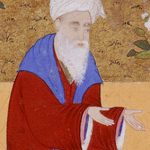
Nezami Ganjavi whose formal name was Niẓām ad-Dīn Abū Muḥammad Ilyās ibn-Yūsuf ibn-Zakkī, is considered the greatest romantic epic poet in Persian literature, who brought a colloquial and realistic style to the Persian epic. His heritage is widely appreciated and shared by Afghanistan, Azerbaijan, Iran, and Tajikistan. He was born in Ganjeh, Azarbayejan.
Because Nezami was not a court poet, he does not appear in the annals of the dyansties. Tazkerehs, which are the compilations of literary memoirs that include maxims of the great poets along with biographical information and commentary of styles, refer to him briefly. Much of this material in these Tazkerehs are based on legends, ancedotes, and hearsays. Consequently, few facts are known about Nezami’s life, the only source being his own work, which does not provide much information on his personal life.
Nezami’s favorite pastime was reading Ferdosi’s Shahnameh. Nezami advises the son of the Shirvanshah to read the Shahnameh and to remember the meaningful sayings of the wise. Nezami has used the Shahnameh as a source in his three epics of “Haft Paykar”, “Khosro and Shirin” and “Eskandar-nameh”.
Khaghani Shirvani
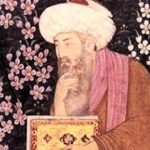
Khāqāni or Khāghāni (1121 – 1190) was a Persian poet. He was born in the historical region known as Shirvan, under the Shirvanshah (a vassal of the Seljuq empire) and died in Tabriz, Iran. Khaqani (real name, Afzaladdin Badil ibn Ali Nadjar) was born into the family of a carpenter. In his youth, Khaghani wrote under the pen-name Haqai’qi (“Seeker”). After he had been invited to the court of the Shirvanshah, he assumed the pen-name of Khaghani.
He soon fled the life of a court poet and set off on a journey about the Middle East. His travels gave him material for his famous poem Tohfat-ul Iraqein (A Gift from the Two Iraqs), the two Iraqs being ‘Persian Iraq’ (western Iran) and ‘Arabic Iraq’ (Mesopotamia). This book also supplies us with a good deal of material for his own biography. He also wrote the famous Ode to the Portals at Mada’in beautifully painting his sorrow and impression of the remains of the ancient Persian Palace at Madaen. On return home, Shah Akhsitan gave order for his imprisonment. It was in prison that Khaqani wrote one of his most powerful anti-feudal poems called Habsiyye (Prison Poem). Upon release he moved with his family to Tabriz where fate dealt with him one tragic blow after another: first his young son died, then his daughter and then his wife. Khaqani composed moving elegies for all three most of which have survived and are included in his divan. Khagani died in Tabriz and is buried at the Poet’s Cemetery in Surkhab Neighbourhood of Tabriz.
Anvari
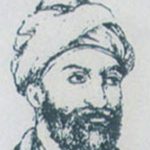
Anvari (1126–1189), full name Awhad ad-Din ‘Ali ibn Mohammad Khavarani was one of the greatest Persian poets. He was born in Abivard of (now in Turkmenistan) and died in Khurasanian Balkh, now in Afghanistan, and studied science and literature at the collegiate institute in Toon (now Ferdows, Iran), becoming a famous astronomer as well as a poet. His references to musical terms in his poetry reval also an expertise in music too.
His surviving divan of poems contain some 15,000 lines. Anvari’s poems were translated into English in 1789, and Cambridge History of Iran calls him “one of the greatest figures in Persian literature”. Despite their beauty, his poems often required much help with interpretation, as they were often complex and difficult to understand.
Attar
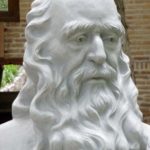
Abū Hamīd bin Abū Bakr Ibrāhīm (1145-1221); better known by his pen-names Farīd ud-Dīn Attār, was a Persian mystic poet, theoretician of Sufism, and hagiographer from Nīshāpūr who had an abiding influence on Persian poetry and Sufism. Information about Attar’s life is rare. He is mentioned by only two of his contemporaries, `Awfi and Tusi. However, all sources confirm that he was from Neyshapur, a major city of medieval Khorasan (now located in the northeast of Iran), and according to `Awfi, he was a poet of the Seljuq period. It seems that he was not well known as a poet in his own lifetime, except at his home town, and his greatness as a mystic, a poet, and a master of narrative was not discovered until the 15th century.
Attar was the son of a prosperous chemist, receiving an excellent education in various fields. He practiced the profession of pharmacy and personally attended to a very large number of customers. Eventually, he abandoned his pharmacy store and traveled widely – to Baghdad, Basra, Kufa, Mecca, Medina, Damascus, Khwarizm, Turkistan, and India, meeting with Sufi Sheykhs – and returned home promoting Sufi ideas. His talent for perception of deeper meanings behind outward appearances enables him to turn details of everyday life into illustrations of his thoughts. He possessed an inexhaustible fund of thematic and verbal inspirations which is reflected in all his poetry. He himself says when he composed his poems, more ideas came into his mind than he could possibly use.
Afzal al-Din Kashani
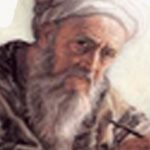
Afzal al-Din Kashani, Baba Afzal, was a Persian poet and philosopher. Several dates have been suggested for his death, with the best estimate being around 1213-1214. The information on his life is scanty and few. His writing portray a disdain for officials of his time and he is said to have once been imprisoned by the local governor on trumped-up charges of practicing sorcery. His tomb located in the village Maraq, northwest of Kashan, is still a place of pilgrimage.
His influence on later thinkers has not been investigated however his works which are clearly and beautifully written were probably a source of inspirtation for philosophical writings in both Arabic and Persian. For his part, he follows the philosophical and logical terminology of Avicenna while most his works evoke a visionary aura in spite of their philosophical and logical exactitude. Besides his poetry, 54 works of prose in varying length have survived.
Around 500 quatrains are ascribed to him. Some of the themes include warnings about the futility of involvement with the things of the corporeal world, the correspondence between microcosm and macrocosm, and self-knowledge as the goal of human existence.
Saadi
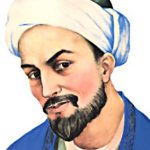
Abū-Muḥammad Muṣliḥ al-Dīn bin Abdallāh Shīrāzī better known by his pen-name as Saadi, was one of the major Persian poets of the medieval period. He is not only famous in Persian-speaking countries, but widely quoted in western sources. He is recognized for the quality of his writings, and for the depth of his social and moral thoughts.
A native of Shiraz, his father died when he was an infant. Saadi experienced a youth of poverty and hardship, and left his native town at a young age for Baghdad to pursue a better education. As a young man he was inducted to study at the famous an-Nizzāmīya center of knowledge (1195–1226), where he excelled in Islamic Sciences, law, governance, history, Arabic literature and theology. Saadi witnessed first-hand accounts of Baghdad’s destruction by Mongol Ilkhanate invaders led by Holaku Khan in 1258. He was later captured by Crusaders at Acre where he spent 7 years as a slave digging trenches.
When he reappeared in his native Shiraz he was an elderly man. Saadi was not only welcomed to the city but was respected highly by the ruler. In response, Saadi took his nom de plume from the name of the local prince, Sa’d ibn Zangi and wrote a number of poems in praise of the ruling house. The remainder of Saadi’s life seems to have been spent in Shiraz.
Shams Tabrizi
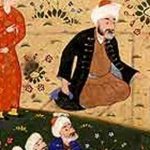
Mohammad Ibn Ali Malekdad Tabrizi, known as Shams Al Din (Shams Tabrizi) is a renouned Persian Sufi poet. He is credited with being the spiritual mentor of Molavi (Rumi). He studied with masters Shams Khoyee (or Khonjee), pir Sajasi and Sale Baf. From his works it is clear he has also been influenced by a number of great thinkers of his time. He himself mentions, Shahab Hariveh, Fakhr Razi, Ohad Al Din Kermani and Ibn Arabi. Not much is known about his life until Maghalate Shams (Shams Articles) was discovered. The oldest documents we had before were written by Soltan Valad (son of Molavi) and Sepahsalar an old friend of Molavi who says “no living soul knew much about Shams, he hid his fame and always covered himself in a shroud of secrets”.
Shams’s entery to Konya and his meeting with Molavi is one of those legendary stories of Iranian culture. The effect of Shams was such that Molavi, a well respected theologian was turned into a distressed person in love. This mysterious old man made the son of the chief clerics to turn away from his teaching duties and join a circle of mystic dance, sama. The peers and followers of Molavi at the theological school become enemies of Shams and the animosities become so public that Shams is forced to leave town. On Molavi’s insistence and the promise of peace by the enmies he is invited back to Konya, but soon the enmities resume. One night sitting in Molavi’s residence he is called to the door. After this he disappears. And from here on the story is not clear. Did they just murder him and throw him in a well nearby (which is the most likely event and the more accepted version today) or did he really disappear. There is no evidence to prove that any of his reputed musoleums in Turkey, Iran or Pkistan have actually anything to do with Shams.
The famous Divan Shams, allegedly written by Molavi after Shams’s disappearance was published 70 years after the death of Molavi. There is no proof that the more than 3000 ghazals in this Divan were written by Molavi or indeed written by one person. At least 5 different styles of poetry can be detected in this collection. Indeed some of the poetry (given their philosophical content) probably belongs to Shams himself.
Owhad-al-din Kermani
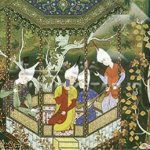
Sheikh Owhad-al-din Hamed abu-al Fakhr Kermani born in Bardsir, Kerman (probably 1173) was a mystic poet. At the age of 16 he migrated to Baghdad and studied and later taught there; until he dropped everything and became a wanderring sufi. He lived in what is now Turkey for many years but returned to Baghdad ans is burried there.
He was influenced by the ideas of Ibn Arabi. He joined the followers of Shams al-din Sajjasi (also one of the teachers of Shams Tabrizi). It is said he was a contemporary of Shams Tabriz and had met him in Damsqus. From all accounts, however, the two had entirely opposing views.
There are over 2000 of his quatrains (robaiiyat) that have survived.
Molavi
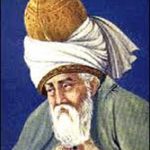
Jalāl ad-Dīn Muḥammad Balkhī, also known as Rūmī and popularly known as Mowlānā or more commonly as Molavi (1207–1273), was a 13th-century Persian poet, theologian, and Sufi mystic. Rūmī is a descriptive name meaning “the Roman” since he lived most of his life in an area called Rūm (present-day Turkey) because it was once ruled by the Eastern Roman Empire.
He was born in Balkh, at that time part of the province of Khorasan. His father decided to migrate westwards for fear of the impending Mogul invasion. Rumi’s family traveled west, first performing the Hajj and eventually settling in the Anatolian city Konya (capital of the Seljuk Sultanate of Rum), as a result of the insistent invitation of ‘Alā’ ud-Dīn Key-Qobād, ruler of Anatolia who wanted Rumi’s father Bahā ud-Dīn Walad to head the theological school in Konya, A position which after his father’s death was occupied by Rumi. This was where he lived most of his life, and where he composed one of the crowning glories of Persian literature, Masnavi, on which he spent the last 15 years of his life and which has profoundly affected the Persian culture and beyond. A book in which even today people find messages of peace and liberation in its stories. Molavi himself said: “I did not write Masnavi so that you place it on the mantelpiece but so that you stand on it to rise higher. It is the ladder to the truth but not one to be taken on shoulders wandering from city to city.”
Rumi’s life was completely changed after his famous meeting with a mystic, Shams Tabrizi on 15 November 1244. After a few weeks with Shams, Rumi was transformed from an accomplished Islamic theologian, teacher and jurist into an ascetic. Shams had travelled throughout the Middle East searching and praying for someone who could “endure my company”. Shams was at first forced to leave Konya and then eventually murdered on his return to Konya by those who wanted to end this friendship with Rumi. On the night of 5 December 1248, as Rumi and Shams were talking, Shams was called to the back door. He went out, never to be seen again.
Rumi’s love for, and his bereavement at the disappearance of Shams found their expression in an outpouring of lyric poems. It is said Masnavi and Divan-e Shams-e Tabrizi were written in this period. Although the latter published many years after the death of Rumi probably contains many poems from Shams himself or added later by others. Rumi’s works were written in the Persian language but occasionally he also used Turkish, Arabic, and Greek in his verse. Molavi was part of a new Persian literary renaissance which started in Khorāsān and by the 10th century it reinforced the Persian language as the preferred literary and cultural language in the Persian Islamic world.
Fakhr-al-Din Iraqi
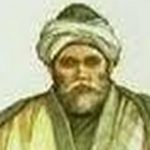
Fakhr al-dīn Ibrahīm (June 10, 1213 – 1289) is one of the great Sufi writers and poets. He was born in Hamadan but during his lifetime he spent many years in Multan, (present day Pakistan) as well as Konya and Toqat (in present day Turkey).
Iraqi was highly educated in both theology and literary disciplines and not only knew Islamic theology but also Persian and Arabic literature. By the time he was seventeen Iraqi begun to teach others. Soon after he began teaching he met a group of wandering dervishes and decided to join them. The group traveled to Multan where he would eventually be in the service of Shaykh Baha’uddin Zakariyya’ Multan who was the head of the Suhrawardi Order.
Iraqi travelled and stayed in Konya too where he met with Molavi. He eventually ended up in Damascus where he would eventually died. Lama’at (or Divine Flashes) is the best known of ‘Iraqi’s writings and was written during his time in what is now present day Turkey. It is in the ‘language of love’ genre within Sufi writings and it takes an interesting view on how one should view the world. Unlike others before him Iraqi viewed the world as a mirror which reflected the Absolute and not as a “veil” which must be lifted.
Awhadi Maraghai
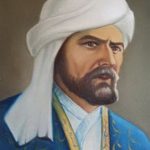
Awhaduddin Awhadi Maragheie (also written Ohadi) (1271–1338) was a Persian poet from the city Maragha in Iran. He is usually surnamed Maraghei, but also mentioned as Awhadi Esfahani because his father came from Isfahan and he himself spent part of his life there. He first chose the pen-name Ṣāfī, but changed it to Awhadi after becoming a devotee of the school of the famous mystic Shaikh Auhaduddin Kermani.
Ohadi has a divan of 8000 verses which consists of the Persian poetic forms Ghasides, Ghazals, Tarji’bands and Quatrains. The Qasidas are in praise of Abu Said and his Vizir, Ghiyath al-Din, the son of Rashid al-Din Fazzlah. His other poems play on various themes including mysticism, ethnics and religious subjects.
In addition to his divan, he has left two important Persian works in Mathnavi. The Dah-nama or Manteq al-Oshaaq consists of 600 verses and was completed in 1307 for Wajih Al-din Yusef, the grandson of the famous Nasir al-Din Tusi. His most important and well known work was the Masnavi Jam-i Jam also called Jam-e-Jahanbin (“The mirror of the universe”). He is burried in Maraghe.
Amir Khosrow Dehlavi
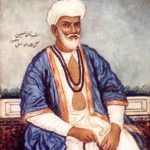
Ab’ul Hasan Yamīn ud-Dīn Khusrow (1253-1325 CE) better known as Amīr Khosrow was a musician, scholar and poet. He was an iconic figure in the cultural history of the Indian subcontinent. A Sufi mystic and a spiritual disciple of Nizamuddin Auliya of Delhi, Amīr Khusrow was not only a notable poet but also a prolific and seminal musician. He wrote poetry primarily in Persian, but also in Hindavi.
He is regarded as the “father of qawwali” (the devotional music of the Sufis in the Indian subcontinent). He is also credited with enriching Hindustani classical music by introducing Persian and Arabic elements in it, and was the originator of the khayal and tarana styles of music. The invention of the tabla is also traditionally attributed to Amīr Khusrow.
Amir Khusrow was prolific in tender lyrics as in highly involved prose and could easily emulate all styles of Persian poetry which had developed in medieval Persia, from Khāqānī’s forceful qasidas to Nizami’s khamsa. He used only 11 metrical schemes with 35 distinct divisions. The verse forms he has written in include Ghazal, Masnavi, Qata, Rubai, Do-Beyti and Tarjiband. His contribution to the development of the ghazal, is particularly significant.
Khwaju Kermani
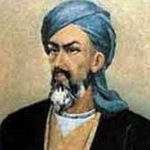
Khwaju Kermani was a famous Persian poet and Sufi mystic born in Kerman in 1290. He was associated with the Persian sufi master Sheykh Abu Esshagh Kazeruni, the founder of the Morshediyyeh order. He is also know as Nakhlband.
When he was young, he visited Egypt, Syria, Jerusalem and Iraq. He also performed the Hajj in Mecca. One purpose of his travels is said to have been education and meeting with scholars of other lands. He composed one of his best known works, Homāy o Homāyun in Baghdad. Returning to Persian lands in 1335, he strove to find a position as a court poet by dedicating poems to the rulers of his time, such as the Il-Khanid and the Mozaffarid rulers.
He was a prolific writer and much of his work has survived (amlost all in Persian). His ideas are said to have had a major influence on Hafez. He was given the title of khallagh-ol ma’ani (creator of meaning). He passed away around 1349-52 in Shiraz, Iran, and his tomb in Shiraz is a popular tourist attraction today.
Mahmud Shabistari
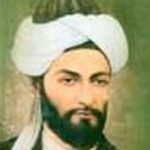
Mahmūd Shabestarī (1288 – 1340) is a celebrated Persian Sufi poets of the 14th century. He was born in the town of Shabestar near Tabriz. He became deeply versed in the symbolic terminology of Ibn Arabi.
His most famous work is a mystic text called The Secret Rose Garden (Gulshan-e Rāz) written about 1311 in rhyming couplets. This work was written in response to seventeen queries concerning Sufi metaphysics posed to “the Sufi literati of Tabriz” by Rukh Al Din Amir Husayn Harawi. It was also the main reference used by François Bernier when explaining Sufism to his European friends in the 17th century.
Other works include The Book of Felicity (Sa’adat-nāme) and The Truth of Certainty about the Knowledge of the Lord of the Worlds (Ḥaqq al-yaqīn fi ma’rifat rabb al-‘alamīn). The former is regarded as a relatively unknown poetic masterpiece written in khafif meter, while the later is his only remaining work of prose.
Seyf Farghani
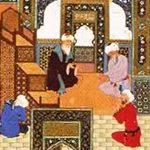
Molānā sayf-edin Muhammad Farghānī (Known as Seyf Farghaani) was a 13th-14th century Persian poet and sufi. He was born in Farghāneh a city in Transoxiana and was burried in Aqsara.
Obeyd Zakani
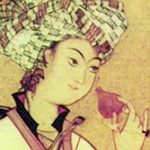
Nezam od-Din Ubeydollah Zâkâni was a Persian poet and satirist of the 14th century from the city of Qazvin. He studied in Shiraz, Iran under the best masters of his day, but eventually moved back to his native town of Qazvin. He however preferred Shiraz to Qazvin, as he was a court poet in Shiraz for Shah Abu Ishaq, where a young Hafez was present as well.
His work is noted for its satire and obscene verses, often political or bawdy, and often cited in debates involving homosexual practices. He wrote the Resaleh-ye Delgosha, as well as Akhlaq al-Ashraf (“Ethics of the Aristocracy”) and the famous humorous fable Masnavi Mush-O-Gorbeh (Mouse and Cat), which was a political satire. His non-satirical serious classical verses have also been regarded as very well written, in league with the other great works of Persian literature.
He is one of the most remarkable poets, satirists and social critics of Iran (Persia), whose works have not received proper attention in the past. His books are translated into Russian, Danish, Italian, English, and German.
Emad Faghih Kermani
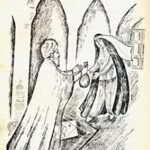
Emad Faghih Kermani is a Sufi poet a contemporary of Hafez and noted by him. His father was a well known Sufi thinker in kerman and had built a khaneghah there. After his death, Emad took over the running of the khaneghah.
He started writing poetry from an early age and was considered a very skilful poet and well received at the court of mozaffarids. Of his works, in addition to his divan of poems, 5 masnavis have also survived. He died in Kerman and was burried there.
Hafez
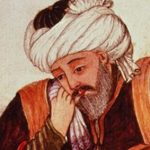
Khwāja Šamsu d-Dīn Muḥammad Hāfez-e Šhīrāzī, known by his pen name Hāfez (1325 – 1389) was a Persian lyric poet. His collection of ghazals are to be found in the homes of most Iranians, who learn his poems by heart and use them as proverbs and sayings to this day. His life and poems have been the subject of much analysis, commentary and interpretation, influencing post-Fourteenth Century Persian writing more than any other author.
Themes of his ghazals are the beloved, faith, and exposing hypocrisy. His influence in the lives of Iranians can be found in Hafez-readings, frequent use of his poems in Persian traditional music, visual art and Persian calligraphy. His tomb in Shiraz is a masterpiece of Iranian architecture and visited often. Adaptations, imitations and translations of Hafez’ poems exist in all major languages.
The question of whether his work is to be interpreted literally, mystically or both, has been a source of concern and contention to scholars. This confusion stems from the fact that, early in Persian literary history, the poetic vocabulary was used by mystics who believed that the divine could be better approached in poetry than in prose and that the specifically Persian as opposed to official Islamic beliefs and value systems could best be hidden in poetry. In composing poems of mystic content, they imbued every ordinary word and image with mystical undertones, thereby causing mysticism and lyricism to essentially converge into a single tradition.
Shah Nimatullah Wali
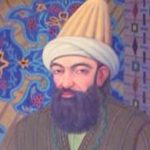
Shah Nimatullah Wali or Ne’matollah Wali, was an Islamic scholar and a Sufi poet from the 14th and 15th centuries. Descended from the Ismaili Imam Muhammad ibn Ismail, Ni’matullah was the Qutb of a Sufi order after his master Sheikh Abd-Allah Yafae. Today there is a Sufi order Nimatullahi that considers him its founder.
Born in Aleppo, Syria, he travelled widely through the Muslim world, learning the philosophies of many masters, but not at first finding a personal teacher he could dedicate himself to. During this time, Ni’matullah also studied the writings of the great Sufi philosopher and mystic Ibn al-‘ Arabi. Ni’matullah met Abdollah Yafe’i in Mecca and subsequently became his disciple. He studied intensely with his teacher for seven years until, spiritually transformed, he was sent out for a second round of travels, this time as a realized teacher.
Ni’matullah temporarily resided near Samarkand, along the great Central Asian Silk Road. It was here that he met the conqueror Tamerlane, but to avoid conflict with the worldly ruler, he soon left and eventually settled in the Persian region of Kerman. His poetry belongs to this period. He has a left a Persian Language Diwan (poetry). His shrine is in nearby Mahan.
Abu Ashagh Atameh
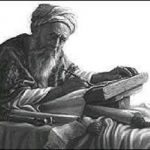
Abu Ashaghe Atameh was a poet famous for his writings on cooking and food. Thus his name Atameh. He was a contemporary of Shah Nimatullah Wali and met him several times. He was born in Shiraz and is burried there. His divan has survived.
Nasimi
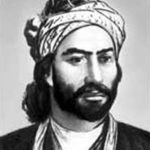
Alī ‘Imādu d-Dīn Nasīmī, often known as Nesimi, born probably in 1369 was an Azerbaijani poet. Known mostly by his pen name of Nesîmî. He composed one divan in Azerbaijani, one in Persian, and a number of poems in Arabic. He is considered one of the greatest Turkic mystical poets of the late 14th and early 15th centuries and one of the most prominent early divan masters in Turkic literary history.
Very little is known for certain about Nesîmî’s life, including his real name. Nasîmî’s birthplace, like his real name, is wrapped in mystery too: it is believed he was born in a province called Nasîm located either near Aleppo in modern-day Syria (or Iraq).
From his poetry, it’s evident that Nasîmî was an adherent of the Ḥurūfī movement, which was founded by Nasîmî’s teacher Fażlullāh Astarābādī of Astarābād, who was condemned for heresy and executed in Alinja near Nakhchivan. Nasîmî became one of the most influential advocates of the Ḥurūfī doctrine and the movement’s ideas were spread to a large extent through his poetry.
Around 1417, as a direct result of his beliefs — which were considered blasphemous by the religious authorities — Nasîmî was seized and, according to most accounts, skinned alive in Aleppo.
Jami
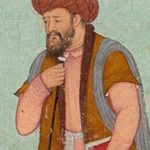
Nur ad-Din Abd ar-Rahman Jami Jāmī (born August 18, 1414 -November 17, 1492), is known for his achievements as a scholar, mystic, writer, composer of numerous lyrics and idylls, historian, and one of the greatest Persian and Sufi poets of the 15th century. Jami was primarily a outstanding poet-theologian of the school of Ibn Arabī and a prominent Sũfī. He was recognized for his eloquent tongue and ready at repartee who analyzed the idea of the metaphysics of mercy. Among his famous poetical works are: Haft Awrang, Tuhfat al-Ahrar, Layla wa -Majnun, Fatihat al-Shabab, Lawa’ih, Al-Durrah al-Fakhirah.
Jami was born in Kharjerd in central Khorasan. Originally his father had come from Dasht, a small town in the district of Isfahan and Jami’s early pen name was Dashti. A few years after his birth, his family migrated to the cultural city of Herat where he was able to study Peripateticism, mathematics, Arabic literature, natural sciences, language, logic, rhetoric and Islamic philosophy at the Nizamiyyah University of Herat. While in Herat, Jami was a central role and function of the Timurid court, involved in the politics, economics, philosophy, religion, and Persian culture. He later went to Samarkand, the most important center of scientific studies in the Muslim world and completed his studies there. He was a follower of the Naqshbandi Sufi Order. He also embarked on a pilgrimage that greatly enhanced his reputation and further solidified his importance through the Persian world.
Navaii
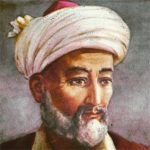
Nizām-al-Din ʿAlī-Shīr Herawī (9 February 1441 – 3 January 1501) was a politician, mystic, linguist, painter, and poet of Uyghur origin who was born and lived in Herat. He is generally known by his pen name Navā’ī (meaning “melodic” or “melody maker”). Because of his distinguished Chagatai poetry, he is considered by many throughout the Turkic-speaking world to be the founder of early Turkic literature.
Mīr Alī Shīr was born in 1441 in Herat, which is now in northwestern Afghanistan. He belonged to the Chagatai amir class of the Timurid elite. His father died while Mīr Alī Shīr was young, and the ruler of Khorasan, Babur Ibn-Baysunkur, adopted guardianship of the young man. He was subsequently educated in Mashhad, Herat, and Samarkand.
Under the pen name Navā’i, Mīr Alī Shīr was among the key writers who revolutionized the literary use of the Turkic languages. Navā’ī himself wrote primarily in the Chagatai language and produced 30 works over a period of 30 years, during which Chagatai became accepted as a prestigious and well-respected literary language. Navā’i also wrote in Persian (under the pen name Fāni), and to a much lesser degree in Arabic and Hindi.
Mohtasham Kashani
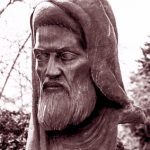
Kamāl-al-Din Mohtasham Kāšāni (1528–1588) was a Persian poet of Safavid’s period. He is mainly known by his elegy on martyrdom of Imam Hossein and his family. he was a follower of the shiite school of “voghoo” and one of the most well known of shiite poets. He was born in Kashan and is burried there.
Sheikh Bahaii
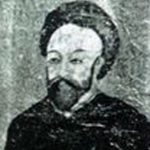
Bahāʾ al‐Dīn Muḥammad ibn Ḥusayn al‐Āmilī (also known as Shaykh‐i Bahāʾī), (1547 – 1621) was a scholar, philosopher, architect, mathematician, astronomer and a poet in 16th-century Iran. He was born in Baalbek, Lebanon. He lived in Jabal Amel in a village called Jaba. Jabal Amel had always been one of the main Shiite centers of west Asia. Even today various Shiite groups live there. They have played an important role in establishing Shiism in Iran, especially from 13th century onwards. The Baha’i (Bahaei) progeny was among those well-known Shiite families. He immigrated in his childhood to Safavid Iran with his father. He is considered one of the main co-founders of Isfahan School of Islamic Philosophy. In later years he became one of the teachers of Mulla Sadra.
He wrote over 88 books in different topics mostly in Persian but also in Arabic. His works include Naqsh-e Jahan Square in Isfahan, as well as designing the construction of the Manar Jonban, also known as the two shaking minarets, situated on either side of the mausoleum of Amoo Abdollah Garladani in the west of Isfahan. Shaykh Baha’ al-Din was also an adept of mysticism. During his travels he dressed like a Dervish and frequented Sufi circles He also appears in the chain of both the Nurbakhshi and Ni’matullāhī Sufi orders. His Persian poetry is also replete with mystical allusions and symbols. He is buried in Imam Reza’s shrine in Mashad in Iran.
Vahshi Bafghi
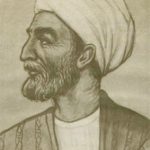
Kamal al-din (or Shams al-Din Mohammad) known by his pen name Vahshi Bafghi was a Persian poet of the Safavid period. Vahshi was born in the agricultural town of Bafq, southeast of Yazd. Vahshi was educated in the town of Yazd before moving to Kashan which was a center of literary activity in the Safavid period. He worked as a school teacher before his poetry attracted the attention of the regional governors. From then on his career was one of serving the courts of various regional governors as well as Safavid Rulers.
Vahshi’s, Farhad and Shirin, a Persian folklore and romantic story of Sassanid Iran is written in the meter of the Persian poet Nizami’s romantic epic Farhad and Shirin. Although the work was left unfinished at the time of Vahshi’s death, with the introduction and barely 500 verses of the story completed, it has been recognized as one of the poets most famous masterpieces.
Vahshi according to one account was said to have died in 1583 at the age of 52 in Yazd. He was buried in this city.
Mir Razi Artimani

Mir Razi Artimani was a famous Safavid poet and mysticborn in Artiman, Tusarkan. He died there and his tomb is still a place of pilgrimage. The famous saghi nameh is his work. He was a student of Mir Morshed Broojerdi.
Saeb Tabrizi
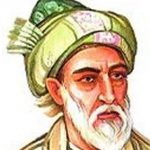
Ṣāʾeb Tabrizi, (Mīrzā Muḥammad ʿalī Ṣāeb, 1601/02-1677) also called Saeib Isfahani was a Persian poet and one of the greatest masters of a form of classical Persian lyric poetry characterized by rhymed couplets, known as the ghazal. In addition to his Persian works, Ṣāʾeb Tabrīzī also wrote poems in his native Azeri.
Ṣaeb was born and educated in the city of Eṣfahān and in about 1626 he traveled to India, where he was received into the court of Shāh Jahān. He stayed for a time in Kabul and in Kashmir, returning home after several years abroad. After his return, Shāh ʿAbbas II, bestowed upon him the title King of Poets.
Ṣaeb’s reputation is based primarily on some 300,000 couplets, including his epic poem Qandahār-nāma (“The Campaign Against Qandahār”). His verses reveal an elegant wit, a gift for the aphorism and the proverb, and a keen appreciation of philosophical and intellectual exercise.
Bidel Dehlavi
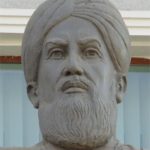
Mawlānā Abul-Ma’āni Mirzā Abdul-Qādir Bidel, also known as Bīdel Dehlavī (1642–1720), was a famous Persian poet and Sufi born in an area of Kabul province in today’s Afghanistan whose parents migrated to India. He mostly wrote Ghazal and Rubayee (quatrain) in Persian and is the author of 16 books of poetry (contain nearly 147,000 verses and include several masnavis). He is considered as one of the prominent poets of Indian School of Poetry in Persian literature, and owns his unique style in it.
Possibly as a result of being brought up in such a mixed religious environment, Bidel had considerably more tolerant views than his poetic contemporaries. He preferred free thought to accepting the established beliefs of his time, siding with the common people and rejecting the clergy who he often saw as corrupt.
Since late 18th century his poetry gradually lost its position among Iranians while it has been much welcomed in Afghanistan, Tajikistan and Pakistan. Bidel came back to prominence in Iran in 1980s. Literary critics Mohammad-Reza Shafiei-Kadkani and Shams Langrudi were instrumental in Bidel’s re-emergence in Iran.
Foroughi
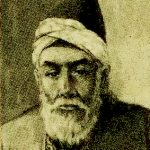
Mirzā Abbās Bastāmi (1798-1857) known by his pen name Foroughi was a Persian poet of Qajar dynasty era. He was born in Karbala, when his family were in the journey of Karbala. He later came to Sari city of Māzandarān with his family and later moved to Tehran. He lived for a period in Bastām and has been called Bastāmi since then. Most of his poems were in ghazal form and he was considered as one of the sufi poets. Around 5000 lines of his poetry has survived
Hatef Esfehani
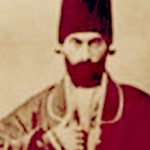
Seyyed Ahmad Hatef Esfehani was a famous Iranian poet of the 18th century. He was born in Isfahan and most likely he died there in 1783. Hatef’s date of birth is unknown. Hatef was contemporary to at least seven rulers of Iran. He studied mathematics, medicine, philosophy, literature, and foreign languages (Turkish and Arabic). Hatef was an expert in the composition of ode. Ode is the poem of complex structure and exalted by lyrical or rhapsodic mood on some stated theme. Another line of his profession was in the writing of Tarji-e-Band. When the linking verse is recurrent, the poem is called a Tarji-e-band (literally: Return-Tie). But when the linking verse is varied, the poem is called a Tarkib-band (literally: Composite-Tie). He was also skillful in the composition of Purposeful Poem (Ghassideh), Elegy (Soognameh), Quatrains (Rubaiyat) and Fragments (Ghata’at). But his reputation lied in his excellent poems of mystical nature.
Hatef has been considered as one of the great Iranian mystic poets who taught many peoples about the higher aspects of the human existence and the journey of the soul. Hatef’s poems are smooth, clear and flowing and free of ambiguities. He followed Saadi and Hafez especially in the composition of his odes. Due to his excellent odes, Hatef is also very well known in many parts of Europe and particularly in Italy.
Tahereh
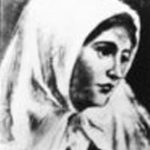
Táhirih or Qurratu’l-`Ayn are both titles of Fatemeh Baraghani (1814 or 1817 – August 16–27, 1852), an influential poet and theologian of the Bábí Faith in Iran. Her life, influence and execution made her a key figure of the religion. The daughter of Muhammad-Salih Baraghani, she was born into one of the most prominent families of her time. As a young girl she was educated privately by her father, Mulla Muhammad Salih Baraghani, and showed herself a proficient writer.
In 1844 aged about 27, she became acquainted with the teachings of the Báb and accepted his religious claims. She soon won renown and infamy for her zealous teachings of his faith and “fearless devotion”. Subsequently exiled back to Iran, Táhirih taught her faith at almost every opportunity. The Persian clergy grew resentful of her and endeavoured to have her imprisoned and stopped.
Táhirih was probably best remembered for unveiling herself in an assemblage of men during the Conference of Badasht. The unveiling caused a great deal of controversy and the Báb named her Táhirih (meaning “the Pure One”) to show his support for her. She was soon arrested and placed under house arrest in Tehran. A few years later in mid-1852 she was executed in secret on account of her Bábí faith.
Muhammad Iqbal
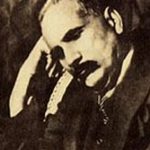
Sir Muhammad Iqbal (November 9, 1877 – April 21, 1938) was a poet and philosopher born in Sialkot, British India (now in Pakistan), whose poetry in Urdu and Persian is considered to be among the greatest of the modern era.
After studying in England and Germany, Iqbal established a law practice, but concentrated primarily on writing scholarly works on politics, economics, history, philosophy and religion. He is best known for his poetic works, including Asrar-e-Khudi—which brought a knighthood— Rumuz-e-Bekhudi, and the Bang-e-Dara, with its enduring patriotic song Tarana-e-Hind. In Afghanistan and Iran, where he is known as Iqbāl-e Lāhorī, he is highly regarded for his Persian works.
Iqbal was a strong proponent of the political and spiritual revival of Islamic civilization across the world, but specifically in India; a series of famous lectures he delivered to this effect were published as The Reconstruction of Religious Thought in Islam. He is officially recognised as the “national poet” in Pakistan. The anniversary of his birth on November 9 is a holiday in Pakistan.
Farrokhi Yazdi
Mirza Mohammad Farrokhi Yazdi (1887–1939) was a Persian poet and a senior politician of the Reza Shah era. Born in Yazd to Ebrahim Yazdi, he had to leave school for work due to poverty at an early age. Yet by the age of 16, he had already started writing poetry.
He became active during the Persian Constitutional Revolution and was imprisoned because of his writings. He was vehemently opposed to the infamous 1919 Anglo-Persian Agreement. In prison, he protested that “He whose only offence is love of the motherland, no creed would condemn to a dark cell…”
In 1921, he published the political newspaper “Toufan” (storm), winning fame for his poetry and constant attacks against Reza Pahlavi in his editorials. He continued with his journalism and political activities and was associated with a number of other radical journals. He was elected to the 7th Majles from Yazd and was one of only two members of parliament who opposed Reza Shah.
He was forced to leave Tehran and go into hiding eventually ending in exile in Germany. On his return to Iran under the promise that he would not be harmed he was harassed and finally, in 1939, arrested and imprisoned at Tehran’s Qasr prison. He was murdered in jail. His grave is still not known.
Bahar
Mohammad-Taqí Bahār (November 6, 1884, Mashhad, Iran — April 22 , 1951, Tehran, Iran), widely known as Malek o-Sho’arā (literally: “the king of poets” – an Iranian version of poet lauriate), is a renowned Iranian poet and scholar, who was also a politician, journalist, historian and a Pprofessor of Literature. Although he was a 20th century poet, his poems are fairly traditional and strongly nationalistic in character.
At 18, he lost his father and started to work as a Muslim preacher and clergy. It was during this time that he composed a long ode and sent it to Mozzafar-al-Din Shah who became so deeply impressed by this ode that he immediately appointed Bahār as his chief court poet and by Royal Decree conferred on him, at the age of 19 (1903), the title of Malek o-Sho’arā.
At the onset of the Constitutional Revolution of Iran (1906–1911), Bahār joined the revolutionary movement for establishing the parliamentary system of democracy in Iran. Bahār became an active member of the Mashhad branch of Anjoman-e Sa’ādat (Society for Prosperity) that campaigned for establishment of Parliament of Iran (Majles). During the rule of the last Shah he also served briefly as the Minister of Culture and Education in Ghavam cabinet.
Mirzadeh Eshghi
Mirzadeh Eshghi, born Seyyed Mohammad Reza Kordestani (1893-1924), was a political writer for republican causes and poet of Iran. He was born in Hamedan, the son of Haj Seyyed Abolghasam Kordestani; he learned French in the Ecole d’Alliance, and moved to Istanbul for a while. He is particularly famous for writing the opera rastakhiz-e shahryaran-e Iran (refferring to a Resurrection of Iran), This was written in Istanbul after he saw the ruins of Taq Kasra on his way there.
After returning to Iran he ended up with his family in Tehran, he published articles and poems in various newspapers and journals in which he fiercely attacked the political system of Iran. He is also remembered for writing six plays; his “noruz nameh” is particularly famous. Another famous play of his is “kafane-siah” (the black death-shroud) about the situation of women under Islam. He published a paper in Tehran called Twentieth Century and predicted in that paper his own early death in the poem “Homeland Love”. He published 17 issues which was stopped due to political pressures. When he resumed publication later; after the first issue it was “officially” banned.
He was eventually murdered on the order of Reza Khan (later, Reza Shah) by two gunmen in his house in Tehran. He is buried in Ebn-e Babooyeh cemetery in Shahr-e Ray, near Tehran. He was one of the first Iranian poets to discuss the concept of New Poetry. The first poems of Nima Yushij, the father of modern poetry in Iran, were published in his journals.
Lahuti
Abolqāsem Lahūtī (1887-1957) was a Persian poet and political activist who was active in Iran during the Persian Constitutional Revolution and in Tajikistanin during the early Soviet era. Born in Kermanshah to a poet by the name Mirza Ahmad Elhami, his first poem was printed in the newspaper Habal al-Mateen in Calcutta at the age of 18.
He soon entered politics and was decorated by Sattar Khan for his efforts for the Constitutional Revolution. Initially, he went to a clerical school, but then went to Bulgaria and wrote many poems about Islam. He then came back to Iran, and enlisted in the armed forces, and graduated as Captain in rank.
After being convicted by a court in Qom to death, he fled to Turkey, but soon returned and joined forces with Sheikh Mohammad Khiabani in Tabriz. His forces defeated Mahmud Khan Puladeen’s troops, but were soon disbanded by freshly dispatched forces. He fled to Baku. While living in Nakhichevan, he became interested in Communism. After marrying a Russian poet, he eventually moved to USSR where he remained until his final days.
Lahuti is the author of the Tajik SSR anthem. Lahuti’s other works include “kave ahangar” (“Kaveh the Blacksmith”, 1947), “qaside kremlin” (“Ode to the Kremlin”, 1923), and “taj va beyraq” (“The Crown and the Flag”, 1935). His collection of poetry, in six volumes, was published between 1960 and 1963.
Iraj Mirza
Iraj Mirza (1874–1926) was an Iranian poet. He is considered as one of the major contemporary poets of the Ghajar period and also as the first Iranian master of colloquial poetry. In his verses he uses the actual words of everyday speech. The origin of this tendency has come to be identified with his name. Through Iraj, poetic language was enriched with many colloquial words and expressions. His simple poetic language is also famous for its witticism and satire directed against tradionalism.
His Father, prince Gholam Hossein Mirza was son of prince Malek Iraj Mirza son of Fat’h Ali Shah Ghajar. Gholam Hossein Mirza was a poet laureate or the official court-poet of Mozaffar al-Din Mirza. Iraj Mirza studied at a branch of the House of Sciences and Techniques (Darolfonoon) in Tabriz. At 15, he was fluent in French, Arabic and Turkish. He was also familiar with the art of calligraphy. His handwriting was very artistic and he was and still is considered as one of the famous calligraphers of Iran.
At 16, Iraj got married and at 19 he lost both his father and wife. He then took the position of his late father and became the court-poet of Mozaffar al-Din Mirza. At 22, when Mozaffar al-Din Mirza became the new Shah, Iraj was titled as the Head of Poets (Sadrol-Shaeryn or Sadrol-Showara). He was then titled as Jalal-ol-mamalek.
Among many poems that Iraj composed, his well-known poems include Satan (Ebleess), Mother (Maadar), A Letter to a Poet Aref Ghazvini (Arefnameh), Woman’s Picture (Tassvir-e Zan), Story of the Veil or Hijab (hejab) and the Story of Zohreh and Manouchehr (Daastan-e Zohreh o Manouchehr). The Story of Zohreh and Manouchehr based on the Greek myth of Venus and Adonis is one of his famous poetic works.
Taghi Rafat
Mirza Taqikhan Raf’at Tabrizi (1887 – 1920), was an Iranian poet, playwright, critic, and journalist.
Rafat was was educated in Istanbul and during World War I returned to Tabriz to teach French in high school. He was a modernist poet who wrote in Turkish and French as well as Persian. Politically, he was a follower of Mohammad Khiabani, and edited the latter’s newspaper, Tajaddod (“Modernity”), an organ of the Democratic Party of Azerbaijan, as well as his own literary magazine Azadestan.
In Azadestan he wrote about the need to break away from the traditional modes in Persian poetry and alongside Shams Kasmaie he is considered one of the first to argue for the new wave in poetry in iran. His declared aim was to “break holes” in the “dam of traditions” in Persian literature. He also wrote plays some of which were staged in Tabriz whilst he was alive.
He was closely associated with Khiabani’s movement in Azerbayejan and was considered his cultural arm. When Khiabani’s movement was violently crushed, Rafat committed suicide.
Aref Ghazvini
Abolghassem Aref Ghazvini (1882 – 1934) was an Iranian poet, lyricist, and musician. He was born in Ghazvin and finished his studies in Persian and Arabic languages there. He is said to have been a good calligrapher. Under the influence of his father he joined the clerics in his youth but after his father’s death he left the clergy.
He later moved to Tehran and became well known in the court of Mozaffareddin Shah. He was even offered a position at court. Aref did not take this up and returned to Ghazvin. He composed many poems about Iran and became known as a national poet. Along with his powerful poetry, he also wrote lyrics for numerous songs and played music.
He was a revolutionary during the Iranian Constitutional Revolution and made many political and pro-revolutionary songs. His most important and impressive works are his taṣnīfāt (song lyrics), which he composed in response to political events of the day and sang to large and enthusiastic audiences. The taṣnīf had sunk to banality in wording and content, but he was able to impart a poetic quality to it.
He had little knowledge of formal music but possessed an extraordinarily keen ear; he was both a good judge of music and an original composer. Despite his boasts of mastery, he owed his fame mainly to the mood of the time and the revolutionary content of his poems. His autobiography and some letters are preserved. He eventually went, or according to one source was banished, to Hamadān where he spent his remaining years in solitude and poverty.
Shams Kasmaie
Shams Kasmaie was born in Yazd, but moved to Eshgh Abad after marrying a tea merchant. After the death of her husband she moved to Tabriz. She, alongside Taghi Rafaat, was one of the first persian poets to break from the traditional mode and embark on modernism. Her first new wave poems were published in Rafaat’s Azadestan in 1920.
She was also a political activist and a fiery writer. She participated in the poilitical movements of the time in Azarbayejan and was a close collaborator of Rafaat. After his death she moved back to Yazd. She remarried and moved to Tehran where she spent the last years of her life in isolation.
Parvin Etesami
Parvin Etesami (1907– 1941), was a Persian poet. She was born in Tabriz to Mirza Yusuf Etesami Ashtiani (E’tesam-al-Molk), who in turn was the son of Mirza Ebrahim Khan Mostawfi Etesam-al-Molk. Mirza Ebrahim Khan Mostawfi Etesam-al-Molk was originally from Ashtiyan, but moved to Tabriz and was appointed financial controller of the province of Azerbaijan by the Qajar administration. Her family moved to Tehran early in her life, and in addition to the formal schooling, she obtained a solid understanding of Arabic and classical Persian literature from her father.
She studied at the American Girls College in Tehran and graduated in 1924. In 1926, she received an invitation to become the tutor of the queen of the new Pahlavi court, but she refused. In 1934, she was married and moved to the city of Kermanshah. But the marriage only lasted for ten weeks and she returned to Tehran.
In 1938-39 she worked for several months at the library of the Teacher Training College (Daneshsaraye Ali). Her father’s death in 1938 bereft Parvin of his loving support and virtually severed her contact with the outside world. Her sudden death only three years after her father shocked the country and was mourned in many elegies. She was buried near her father in Qom.
In her short life, she managed to achieve great fame. Parvin’s poetry follows the classical Persian tradition its form and substance. She remained unaffected by or perhaps ignored the modernistic trends in. In the arrangement of her poetry book, there are approximately 42 untitled Qasidas and Qet’as. These works follower a didactic and philosophical styles of Sanai and Naser Khusraw. Another form of poetry, the monazere (debate), claims the largest portion of Parvin’s Divan. She composed over sixty poems in the style of monazere. In these “debates” she eloquently expresses her basic thoughts about life and death, social justice, ethics, education, and the supreme importance of knowledge.
Nima Yushij
Nimā Yushij (November 12, 1896 – January 6, 1960) was a contemporary Persian poet who started the she’r-e no (“new poetry”) movement. He is considered as the father of modern Persian poetry. He died of pneumonia in Shemiran, in the northern part of Tehran and was buried in his native village of Yush, Nur County, Mazandaran, as he had willed.
He grew up in Yush, mostly helping his father with the farm and taking care of the cattle. As a boy, he visited many local summer and winter camps and mingled with shepherds and itinerary workers. Life around the campfire, especially images emerging from the shepherds’ simple and entertaining stories about village and tribal conflicts, impressed him greatly. These images, etched in the young poet’s memory waited until his power of diction developed sufficiently to release them. At the age of twelve, Nima was taken to Tehran and taught at a Roman Catholic school.
Nima started his poetry in the traditional style but gradually realized that the traditional devices are impeding his free flow of ideas. At a certain stage of this gradual change Nima became aware that he has to break completely from this tradition and create his own innovative poetic devices to that enhanced the free flow of concepts. The new poetry was thus born.
Gholamreza Rouhani
Sayyed Gholamreza Rouhani (17 May 1897 to 29 August 1985) was a humorous poet. Professor Mohamad Ali Jamalzadeh called him “The chief of humorous poets”. His father, Sayyed Mirza Shokrollah (known as Azadi) and his grandfather Mirza Mohammad Tafreshi (known as Ali), were both poets of the Qajar era. Gholamreza Rouhani was born in Mashhad. In 1919 his first collection of poetry was published in in Teheran.
In 1921 Rouhani joined the Literary Society and in 1923 he became associated with some theater and music clubs including “Jameh Barbad” which was founded by Professor Ismael Mehrtash. Rouhani wrote many humorous poems for the theater and many of them became publicly famous.
Rouhani was also active in creating songs as well as serious and humorous poems for music and theater. His brand of humorous poems was not widley recognized in the new period of Persian literature and very little was known about them. Gradually his poems became a valuable source of inspiration for young people. Today in Iran there are numerous “humorous” societies named after him.
Zandokht Shirazi
Zandokht Shirazi (1909–1953) was a prominent Iranian feminist, poet and school teacher, who was an active campaigner for women’s rights from an early age.
She established Majma’ e Enghelabi e Nesvan [Revolutionary Association of Women] in Shiraz in 1927, at the age of 18, and published Dokhtran Iran [Daughters of Iran] newspaper on women’s issues from 1931 initially in Shiraz.
She has been called the first Persian radical feminist . Her poetry was ignored for a long time and many of the anthologies on Iranian literature fail to mention her name.
The opposition to her views and her increasing isolation led to a deep depression which alongside poverty and her deteriorting physical health caused her early death.
Shahriar
Seyyed Mohammad Hossein Behjat-Tabrizi known by his pen name as Shahriar was a legendary Iranian poet of Azeri origin, wrote in Persian languages and Azerbaijani language. Shahriar was one of the first Iranians to write significant poetry in Turkish. He published his first book of poems in 1929. His poems are mainly influenced by Hafez. His most famous poem Heydar-Babaya Salam, in Turkish, Published in 1954, won the immense affection of both the Turkic and Iranian speakers. Heydar Babaya Salam is translated into more than 30 languages. Shahriar is considered to be among the best modern poems in Azari language and some of his work has been turned into plays.
Shahriar’s verse takes diverse forms, including lyrics, quatrains, couplets, odes, and elegies. One of his love poems, Hala Chera, (why now?) was set to music by Rouhollah Khaleghi. The composition for orchestra and solo voice became one of his most well-known of his works.
One of the major reasons for the success of Shahriar’s work is the sincerity of his words. Since he uses slang and colloquial language in the context of poetry, his poems are understandable and effective for a broad segment of the public. His day of death is named the “national day of poem” in Iran.
Fereidoon Tavalloli
Fereydoon Tavalloli (1919–1985) was born in Shiraz and grew up in a traditional and wealthy family. His primary education was at home with private tutors. As poetry was a cornerstone of the teaching methods, he was introduced to Persian poetry very early on. Reading the works of Rudaki, Ferdosi, Nezami, Sadi, Hafez and Molavi, as he was learning to read. This set the tone for the rest of his life. The poets’ messages, philosophy and rebellion was imprinted into his character. His family background and culture of the Qashqai nomads of the mountains of Fars province provided the mold. As a result, he was both a rebel and a poet from early childhood.
Shiraz at the time was a hotbed for poetry and literature, not only due to its history and nature but also due to the fact that the government had banned almost all other socio-political activity. Throughout his high school years Tavallali formed and led poetry and social clubs at school. He also occasionally confronted the authoritarian rulers of the country through speeches and writings at these clubs. He entered the Tehran University in 1938 and studied linguistics.
He published his first book called “Al-tafasil” in 1946. This was a compilation of his newspaper published articles. His later works were almost all poetry.
Shamlu
Ahmad Shamlou also known under his nom de plume A. Bamdad (December 12, 1925 — July 24, 2000) was a Persian poet, writer, and journalist. Shamlou is arguably the most influential poet of modern Iran. His poetry was initially very much influenced by and was in the tradition of Nima Youshij.
Shamlou’s poetry is complex, yet his imagery, which contributes significantly to the intensity of his poems, is simple. As the base, he uses the traditional imagery familiar to his Iranian audience through the works of Persian masters like Hafez and Omar Khayyám. For infrastructure and impact, he uses a kind of everyday imagery in which personified oxymoronic elements are spiked with an unreal combination of the abstract and the concrete thus far unprecedented in Persian poetry, which distressed some of the admirers of more traditional poetry .
Shamlou has translated extensively from French to Persian and his own works are also translated into a number of languages. He has also written a number of plays, edited the works of major classical Persian poets, especially Hafez. His thirteen-volume Ketab-e Koucheh (The Book of Alley) is a major contribution in understanding the Iranian folklore beliefs and language. He also wrote fiction and Screenplays, contributing to children’s literature, and journalism.
Fereydoon Moshiri
Fereydoon Moshiri (born August 1926 in Tehran, Iran – died October 24, 2000 in Tehran) was one of the prominent contemporary Persian poets who versified in both modern and classic styles of the Persian poem. He is best known as conciliator of classical Persian poetry at one side with the New Poetry initiated by Nima Yushij at the other side. One of the major contributions of Moshiri’s poetry is the broadening of the social and geographical scope of modern Persian literature.
Fereydoon Moshiri was born in Tehran to a family known for their legacy of poetry. His school years were divided between Tehran and Mashhad where his father held administrative posts. With the outbreak of the World War II the family moved to Tehran and the young Moshiri continued his education at Dar ol-Fonoon and then in Adib High School. Throughout these years his first poems appeared in progressive journals such as Iran-e-Ma. This was the beginning of a career in literary journalism that continued for more than thirty years.
Moshiri’s first volume of poetry titled Teshne-ye Toofan (Thirsty for the Storm) was published in 1955. His lyrical poems were widely received and left an impact on a generation of younger poets. Later works which were published under the titles “Abr-o-Koocheh” (The Cloud and The Alley, 1962), and “Bahar Ra Bavar Kon” (Believe The Spring, 1967) embraced a wide variety of universal concepts ranging from humanistic considerations to social justice. A selection of his poems has been translated into English entitled ‘With All my Tears’ by Ismail Salami.
Siavash Kasraie
Siavash Kasraie (February 25, 1927, Isfahan – February 8, 1996, Vienna) was an Iranian poet.
Kasraie graduated from Tehran University, Faculty of Law. He was a native of Isfahan. His first collection of poetry was published in 1957 followed in 1959 by “Arash the Archer”, based on the mythological tale of Arash. The second collection of poetry brought him to fame immediately. He was from the first group of Iranian poets who followed Nima’s new poetry.
Kasraie was a member of the Tudeh Party and was forced into exile in 1983 after the Islamic regime in Iran turned against most of their earlier supporters such as the Tudeh party. He lived his last years in exile, first in Kabul and Moscow and then, after the collapse of the Soviet Union in Vienna.
Simin Behbahani

Simin Behbahani (July 20, 1927, Tehran – 19 August 2014 ) is one of the prominent figures of contemporary Persian poetry. She is considered today as Iran’s national poet and an icon of the Iranian intelligentsia and literati who affectionately refer to her as the “lioness of Iran”. She has been nominated twice for the Nobel Prize in literature, and has received many literary accolades around the world.
Simin Behbahani, started writing poetry at twelve and published her first poem at the age of fourteen. She used the “Char Pareh” style of Nima Yooshij and subsequently turned to ghazal. Behbahani contributed to a historic development by adding theatrical subjects and daily events and conversations to poetry using the ghazal style of poetry. She has expanded the range of the traditional Persian verse forms and has produced some of the most significant works of the Persian literature in 20th century.
In March 2010 she was refused permission to leave the country. As she was about to board a plane to Paris, police detained her and interrogated her. She was subsequently released but without her passport stopping her from travel abroad. She participated in the first Toos Foundation event in celebration of Lobat Vala.
Behbahani was hospitalized in Tehran on 6 August 2014. She remained in a coma from 6 August until her death 19 August 2014. She died in Tehran’s Pars Hospital and she was 87. Her funeral was held on 22 August in Vahdat Hall and her body was buried at Behesht-e Zahra.
Bijan Jalali
Bijan Jalali (born 1927 in Tehran, Iran) is a renowned modern Persian poet. Sadegh Hedayat who had a major influence on his work was his uncle. He studied French literature at Tehran University. Jalali’s first volume of poetry was published in 1965. he was well known for his simplicity and directness. The Color of Waters (1971) reflects Jalali’s concern for more free forms.
In his unpretentious poems, he reflects moments of pain and boredom by brief words and passing images. His best poems portray vivid images in the mind. He is the most contemplative modern poet and reflects different philosophical thoughts with an intimate language, which never tires the reader. Many of his works have been published posthumously.
Sohrab Sepehri

Sohrab Sepehri (October 7, 1928 – April 21, 1980) was one of the notables of modern Persian poetry. He was also a painter, the influence of which can be seen in the unique imagery he uses in his poems. He was born in Kashan in Isfahan province. He will be in any one’s list of the five most famous and read modern Persian poets.
His poetry is full of humanity and concern for human values. He loved nature and refers to it frequently in all his poems. Well-versed in Buddhism, mysticism and Western traditions, he mingled the Western concepts with Eastern ones, thereby creating a kind of poetry unsurpassed in the history of Persian literature. To him, the new forms were the essential new means he needed to express his thoughts and feelings.
His poetry has been translated into many languages including English, French, Spanish, German, Italian, Swedish, Arabic, Turkish and Russian.
Hushang Ebtehaj

Hushang Ebtehaj (1928-2022), with the pen name of Sayeh is an eminent Iranian poet of the 20th century whose life and work spans many of Iran’s political, cultural and literary upheavals.
He was born February 25, 1928 in Rasht, Iran, and had his primary schooling there before moving to Tehran. His first book of poetry, with an introduction by eminent poet Mehdi Hamidi Shirazi, was published when he was 19 years old. During Iran’s open period following WWII, Sayeh got involved in various literary circles and contributed to various literary magazines such as Sokhan, Kavian, Sadaf, Maslehat, and others.
After the 1979 Iranian Revolution and the ensuing suppression, Sayeh spent a year in prison for his writings. After his release, he began work on “Hafez, by Sayeh,” a verse-by-verse study of the various publications of Hafez. In 1987, he moved to Cologne, Germany, with his family and lives there. In his poems, he is shown as a highly motivated person in love, who has gone through years of pain and suffering.
Mehdi Akhavan-Sales
Mehdi Akhavān-Sāles, was a prominent Iranian poet. He is one of the pioneers of New Style in Persian Poetry. Akhavan Sales was born in 1928 in Mashhad, Iran. In 1990, following an invitation from the Germany, he traveled abroad for the first time. Few months after his return, he died in Tehran. He is buried on the grounds of the mausoleum of Ferdosi in Tus.
Although Akhavan Sales’s poetic career began as early as 1942, he did not acquire the degree of recognition necessary for breaking into the literary circles of his time until the publication of his third volume of poetry in 1956, called “zemestan” (Winter). This work placed him among the top runners for the mantle of Nima Yushij. In fact, for many literary circles, Nader Naderpour and Akhavan Sales were equally recognized as worthy successors of Nima. Like him, Akhvan also started as a traditionalists and had to work his way into new realms of New Poetry.
khavan’s forte is epic poetry; more precisely, he chooses themes of epical proportions. His language is complex. One cannot ignore the impact of the internal rhyme, the interconnection of seemingly disparate images, and the ubiquitous presence of the theme. Sales’s “Winter,” is a good example for understanding the depth of his conviction as well as the dexterity and the finesse that distinguish his compositions.
Nader Naderpour
Nader Naderpour (6 June 1929 – 18 February 2000) was one of the many Iranian poets who shaped up the New Persian Poetry. Nader Naderpour was born in Tehran. His parents were both fluent in French with a deep love for art, music and history. The eldest of two brothers and three sisters, Naderpour grew up under the supervisions and cares of his culturally rich parents.
In 1942 during World War II, Naderpour entered Iran-Shahr High School of Tehran. A year later when Iran was occupied by the Allied military forces, Naderpour became involved in politics and joined nationalist group. Later he joined the Tudeh Party of Iran (the pro-Soviet Communist Party of the country). He published a number of poems in the Party Journals. Later he left the Tudeh Party and became sympathetic to the National Front and its leader, Mohammad Mosaddegh. He worked with the wing of Front known as the Third Force (under Khalil Maleki).
In 1971, Naderpour took over as the director of Contemporary Literature Department in the National Iranian Radio & Television, where he directed many programs on the life and works of contemporary literary figures. Naderpour fled the Iranian Revolution in 1980.
Nosrat Rahmani

Nosrat Rahmani (1929-2000) was an Iranian poet and writer. He was born in the slums of Tehran. He received his college degree from Ministry of PTT. After just a few years of services in the Ministry, Nosrat Rahmani sought employment with the state radio. Subsequently he abandoned government employment for journalism and freelance writing. He was for a while the ditor of the poetry section in Zan-e Rooz (Today’s Woman) magazine.
His poetry is the poetry of the stubborn, humiliated and revolting down-town people in Tehran’s slums; he never forgot his concern for the plight of the urban poor. His memoirs entitled, The Man Lost in the Dust (1957), provide an emotional account of the life of an addict. During the 60’s and 70’s, Rahmani was especially popular among the youth. As a whole, his poetry is dramatic in structure and fantastic in effect, often attempting to recapture the past by poeticizing its recollections.
He died in Rasht at the age of 71 and has left numerous collections of his poetry.
Mehrdad Avesta
Mehrdad Avesta (real name Mohammad Reza Rouhani) was born in Brojerd in 1931. He is well known for his Ghasideh poems and some consider him the foremost exponent of this form in contemporary era. Ghaside (literally means “intention”) is a form of petition to a patron. Often it is written in a panegyric form in praise of a king or a nobleman.
He grew up in a literary family and started writing poems from an early age. He did not however publish any of his early work as he considered them to be inferior to the ghasidehs he developed later. He studied philosophy at Tehran University and worked as a lecturer after graduation. At the time he was considered to be the youngest ever lecturer at Tehran university.
He wrote few poems in opposition to the Shah which got him imprisoned for a short period. He published his first collection of poems in 1960. He was in corespondence with a number of French thinkers and travelled to France on a number of occasions. jean Paul sartre considered him “a great eastern thinker”.
Lobat Vala

Lobat Vala (born in Tehran, 1930) is a contemporary Persian poet born in 1930 in tehran. As one of the first Iranian women journalist she was the editor of a weekly women’s magazine, and later, the literary section of the weekly “Tehran Mossavar”. She has also been one of the pioneer campaigners for women’s Rights in Iran. She was also employed by the Ministry of Art and Culture as the art director of literary and musical programs for television and radio.
She has been living in exile since 1979. First in Australia, where she obtained a degree in Middle Eastern Studdies from Melbourne University. She is currently living in London. She has published several short stories, novels and poetry books in Persian and a selection from her poems has been translated into English.
Manouchehr Atashi
Manouchehr Atashi (1931-2005) was a Persian poet, writer, and journalist. He was the last direct student of Nima Yushij. He was born in Dashtestan, Bushehr province in the warm southern coastal regions of Iran and with vivid image of the desert environment and tribal life.
His took his roots seriously and his poems are the poems of the warrior horsemen of the humiliated southern tribesman. Although attached to his native birthplace his poems are universal. In his later works Atashi has relaxed moved towards a direct form of expression of emotion. He was a rare poet who created his own special language and diction in modern Iranian poetry.
Yadollah Royaee
Yadollah Royaee – More Information (born 1932 in Damqan, Semnan Province, Iran) is the poet of the New Wave. His poetry renewed debate about the relative value of form and context in modern Persian poetry. Royaee is careful to produce unity in his poems. His sea songs reflect French symbolism. He moves to exotic marine landscapes creating glorious lyrical scenes, focusing mostly on symbols rather than metaphors in image building.
He was politically active in his youth and was arrested and imprisoned for being a member of the Tudeh Party after the 1953 coup. He started writing poetry after his release from jail. He also graduated in international law.
His lyrics are deeply imbued with Persian mysticism. Royaee also invented and introduced a new style in Persian poetry which he named Spacement Poetry. Some of his works have been translated into French. He is currently living in Paris.
Farrokh Tamimi
Farrokh Tamimi, an Iranian poet and author, was born in Neishabour. Losing his father at the early age of two, he was raised by his mother in Tehran. Tamimi studied accounting and for many hears worked as an account executive in several major manufacturing companies.
Since the 1950’s he began writing poetry, showing interest in the experiments of Fereidoon Tavallali. He soon joined the group of Modernist Iranian Poets (the New Wave), influenced by the poems and views of Nima Yushij (1887 – 1959). His work then was well known as one of the second generation of modernist poets such as Royaee, M. Azad and F. Farrokhzad.
In terms of form and style, Tamimi believed in freedom from the prosody of the Classical Persian Poetry. In terms of themes, he was at first concerned with social and national issues, and later he reflected aspect of city life in his poems. In addition, manifestations of nature evokes a tender atmosphere in some of his poems.
Tamimi has also written other books and translated several books from English into Farsi.
M. Azad
Mahmoud Moshref Azad Tehrani (Tehran 1934 – Tehran 2006) was a contemporary Persian poet with M. Azad as his pen name. Some of his poems have been sung by Iranian singers. Gol-e Bagh-e Ashenaii (the flower of acquaintance garden) is one of his most famous poems.
M. Azad has four collections of poems: Diar-e Shab (The land of night), Aaineh ha Tohist (The mirrors are empty), Ghasideh-ye Boland-e Baad, (The long ode of wind) and, Ba Man Toloo Kon (Rise with me) and a collection of poems, with the title of Gole Baaghe Aashnaai, published in year 2000, comprising 482 pieces from above books and 108 new pieces.
In addition to poetry, he also wrote about 50 books for sub-teens and teenagers. Many of his poems are used in Persian literature books in schools in Iran.
Forough Farrokhzad
Forugh Farrokhzād was an Iranian poet and film director. She is arguably one of Iran’s most influential female poets of the twentieth century. She was born in Tehran. At the age of sixteen she was married to Parviz Shapour, an acclaimed satirist. Farrokhzad continued her education with classes in painting and tayloring and moved with her husband to Ahvaz. A year later, she bore her only child, a son named Kāmyār (subject of “A Poem for You”).
Within two years, in 1954, Farrokhzad and her husband divorced; and she moved back to Tehran to write poetry and published her first volume, entitled The Captive, in 1955. Farrokhzad, wrote controversial poetry with a strong feminine voice, and soon became the focus of much negative attention and open disapproval. In 1958 she spent nine months in Europe and met the Iranian film-maker and writer Ebrahim Golestan, who reinforced her own inclinations to express herself and live independently. She published two more volumes, The Wall and The Rebellion before traveling to Tabriz to make a film about Iranians affected by leprosy. This 1962 documentary film titled The House is Black won several international awards.
In 1963 she published her most famous collection of poetry, Another Birth. Her poetry was now mature and sophisticated, and a profound change from previous modern Iranian poetic conventions. On February 13, 1967, Farrokhzad died in a car accident at age thirty-two.
Manouchehr Neyestani
Manouchehr Neyestani was a native of Kerman and a secondary school teacher. He is considered as one of Iran’s most plebeian poets. He would often put his radical social criticism into witty and decidedly nonacademic poems. Many of these sustain their vividness through a portrayal of life in factories, hospitals and even graveyards.
Manouchehr published his first volume of poetry, The Bud, at the age of 15. He published half a dozen other books of poetry, translations and children’s tales after that.
In his poetry, Neyestani has consistently tried to get away from the notion of the poem as a sort of display of literary virtues. Where this is accomplished, his poetry shines in simplicity and effectiveness, without appearing stale or trite. The anti privilege tone of his poetry, together with a deep sense of ordinary experience makes him something of a spokesman for proletarian concerns. Factory, a famous poem of his, portrays the estrangement and alienation born and bred in the utterly antipoetic atmosphere of a factory. He makes his impact through a series of images that are brought together in simple cadence of language and a straightforward syntax.
Mohammad Hoghoughi
Mohammad Hoqouqi (1937-2009) was an Iranian poet and critic. He was born in Isfahan and after graduating in Iranian Literature he taught for a number of years in both Isfahan and Tehran. He published a literary magazine “Jonge Isfahan” for a number of years and has left many collections of his own poetry.
Of the more than 30 books he has published one of them Modern Poetry, from Beginning until Today, reprinted many times, is considered one of the leading encyclopedic sources on modern Iranian poetry.
He was an exact and untiring critic of the modern Persian poetry carefully selecting those poets, who have left a new style in modern poetry. He wrote many important essays on many of the mdern Iranian poets including Nima Yushij, Foroogh Farokhzad, Ahamd Shamlu, Sohrab Sepehri, Akhvan Saless.
Esmaiil Khoyi

Esmail Khoyi is an Iranian poet born in 1938 in Mashad, Iran, currently living in exile in the United Kingdom. With his background in philosophy he has often been called a philosophical poet. His poetry, mixing a defiant persona with the philosophical musings of a contemplative intellectual is both unique and deeply rooted in the best traditions of Persian poetry.
He has gone beyond chronicling his own life in exile to defend human rights and political freedom the world over. He has continued to speak out for the rights of Salman Rushdi, Taslima Nassrin and others. Khoi’s poetry bears eloquent testimony to his experience and thought, and to his life long quest for a more humane world.
Selections of his poems have been translated into several languages. English translations of his selected poems have appeared in book form, in the US and Canada.
Nemat Azarm
Nemat Mirzazadeh (known as Nemat Azarm) is a Persian poet born in Mashad 1939. Currently living in exile in Paris. He is one of the founding mebers of the Iranian Writers Association and was imprisoned during the last Shah for his poilitical activities.
He started his literary activities in Mashhad in the early 1960s with the publications Khorasan-e Adabi (Lietrary Khorasan) and Mahaneh Hirmand (Hirmand Monthly). Since then he has published 16 collections of poetry.
Shafiei Kadkani

Mohammad Reza Shafi’ee Kadkani (born 1939) is a Persian writer, poet, literary critic, editor, and translator. Born in kadkan Razavi, Khorasan (near Nishapur), Shafiei-Kadkani graduated from Tehran University with a doctorate degree in Persian literature. He was a student of prominent literary figures such as Badiozzaman Forouzanfar, Mohammad Moin, and Parviz Natel-Khanlari.
He is currently professor of literature at Tehran University. Shafiei-Kadkani is known for his works on literary criticism and modern Persian poetry. His own poetry evolved from an earlier traditional style to the new wave started by Nima Yushij. His poems have a social content and his earlier works convey a vivid picture of Iranian society during the 1960s and 70s.
He has published a number of works including many works of literary criticism. With his interest in the music of poetry Kadkani has also developed a keen interest in Iranian traditional music and is now considered a major comentator in that field.
Javad Mojabi

Javad Mojabi (born 1939 in Qazvin, Iran) is an Iranian poet, writer, researcher, and literary critic. He graduated in Economics from Tehran University.
Mojabi has written hundreds of critical works and essays on art and culture in journals and magazines. He began writing poetry in the 1960s, along with short story writing and research on modern painting in Iran. He is also a well-known satirist. He was for a short period the editor of the literary journal, Sokhan.
The poet close to him is Nima in style but he was also strongly inclined towards Shamlou, mostly focusing on social themes. Mojabi is a poet of philosophy and thought, which he sweetens with a blend of satire. He employs the meter but omits it when it prevents him from expressing his thoughts. He has a daughter, Poupak, on whom he bases some of his works.
Hamid Mosadegh
Hamid Mosadegh (1940, Shahreza, Isfahan-1998, Tehran) was a contemporary Iranian poet, author and lawyer.
He went to Tehran in 1960, and graduated from University of Tehran, and his Masters degree in Economy. In 1966, he left Iran to study Law in England. From 1981, he began teaching law, at the Law School of University of Tehran. Besides working as a lawyer, he continued writing poems and publishing some of them. His career as a lawyer was strongly affected by his life as a poet and his political concerns. Most of his defendants were other Iranian authors and artists, such as Simin Behbahani, another famous Iranian poet.
In the words of critics one of the distinctive features of his poems is simplicity, fluency and sincerity. As Simin Behbahani argued: “Mosaddegh associated humanistic goals with poetry.” Hamid Mosaddegh was close to the heart of Iranian people and his poems are understandable and easy to connect with for people of various ages and classes.
In 1998, he died after a heart attack. He is buried in “Ghate’ye Honarmandan” in Tehran. On his tombstone it has been written: “Remember us, whom in all life’s night, Prowl for searching twilight. Remember us kindly and by heart.” The words are from one of his last poems.
Mohammad-Ali Sepanlou

Mohammad Ali Sepanlou (born in Tehran 1941) is an Iranian poet, writer and literary figure. He was a co-founderof the Iranian Writers Association, in which capacity he opposed both the former regime of Shah and the government of the Islamic Republic, speaking out against censorship.
Sepanlou received his diploma from Dar ul-Funun high school. He graduated from Tehran University’s Faculty of Law in 1963. He has since published over 50 books. In addition to poetry he has written extensively on Iranian cultural history and is a well known exponent of Iranian literature internationally.
In the beginning, Sepanlou adopted the style of Fereydoun Tavallali, who acted as a bridge between classic and modern poets. He then followed Nima Yushij and Ahmad Shamlou, and later assimilated the style of Siavash Kasraei, Forough Farrokhzad and Mehdi Akhavan Saales.
Mohammad Mokhtari
Mohammad Mokhtari (1942-1998) was an Iranian poet and writer who was murdered on the outskirts of Tehran in the course of the notorious “Chain Murders of Iran” by the security services of the Islamic regime. He left his residence at five o’clock in the afternoon of December 2 1998, reportedly to buy light bulbs on Jordan Boulevard in north Tehran. His body was identified at the coroner’s office on December 8 1998, he had died of suffocation. His murder came a few days after that of another writer Majid Sharif. He was interrogated and threatened by Intelligence Ministry a few times before to stop working at Kanun-e Nevisandegan (Iranian Writers Association).
His murder was initially blamed on a foreign “network”. Later, blame was placed upon “rogue elements” in the intelligence ministry. He was a political prisoner for a few years after the Islamic Revolution of Iran. He served at bonyad-e-shahname before 1979.
Mokhtari was a member of a group of writers who helped to re-establish the Iranian Writers Association.
Mahmoud Shojaee

Mahmoud Shojaee (1942-2015) was a poet, playwright and painter, born in Ahar in East Azarbaijan province. He graduated with a Master’s degree in architecture at the Faculty of Fine Arts .
He was one of the founders of volume poetry. a new trend in modern Iranian poetry which announced its existence in1967. Poets such as Yaddollah Royaee and Parviz Islampour wrote manifestos for volume poetry which were published in the literary magazine Barrow (1969).
Bijan Elahi

Bijan Elahi (1945-2011), was a prolific poet, painter, essayist, translator, and one of the pioneers of the Iranian New Wave in literature. He has been described as the “poet of silence,” alluding to his quiet last years in a tacit retaliation toward the suffocating atmosphere that was crippling artist and intellectual life in Iran.
He had translated Nabokov, Lorca, Joyce, and Kafka and studied Picasso and taught a generation of writers and poets to disregard the form, the platform, the rules. He wrote: “Poetry is chasing the truth through back alleys – such is the creed of relations. But it is only through the course of relations, that you can recognize the back alleys.”
Varand

Varand (Soukias Hacob Koorkchian), born 1954, in Tehran, is an Iranian Armenian poet, playwright, lyricist, author, translator and painter. He has published 27 collections of poetry since 1972.
Varand was honoured as Professor of Armenian Literature by the Grigor Lusavoritch University of Etchmiadzin, Armenia in 2001. He translates both Persian classics as well as modern poetry into the Armenian language.
Varand was the chairman of the Armenian Writers Society of Iran founded in 1961 for over ten years, while recently elected chairman of the board for the organization. He is also the editor in charge of the cultural department at Armenian daily newspaper of “Alik”, an honorary member of the Writers Union of Armenia in Yerevan and the professor of the Armenian literature at Azad University of Tehran.
Ziba Karbasi

Ziba Karbasi was born in 1974 in Tabriz. She left Iran in 1989 and now lives between London and Paris. She has published five volumes of poetry in Farsi, all outside Iran, and continues to write prolifically. Her poetry tackles difficult themes with a mastery of craft and has received wide critical attention.
She has been translated into several languages. An entire volume of her poetry is being translated into English. She was recently voted as Director of the Association of Iranian Writers in Exile. Ms. Karbasi tours on a regular basis to present her work and participate in various events.
Sheema Kalbasi

Sheema Kalbasi (born 1972 in Tehran) is a poet, producer, critic, blogger, and human rights advocate. Kalbasi is the founder and president of Reel Content, a film production and publishing company. She is the director and the co-director of several literary projects including the Other Voices International project. She has published two books of poetry and two anthologies of poems. Her poems have been anthologized and translated into eighteen languages to date.
Kalbasi’s work is distinguished by her passionate defense of ethnic and religious minorities’ rights. She has done voluntary teaching and tutoring of Baha’i refugee children as well as Iraqi Kurdish children, and disadvantaged Pakistani children in Pakistan. Kalbasi has worked for the United Nations and the Center for non Afghan Refugees in Pakistan, and in Denmark. She currently resides in Washington, DC.
Granaz Moosavi

Granaz Moussavi (born 1974 in Tehran) is an Iranian contemporary poet, film director and screen writer. She is primarily renowned for her avant-garde poetry in the 90’s. In 1997, Granaz immigrated to Australia with her family. She has changed focus to Screen Studies and film making. Her award winning debut feature film “My Tehran For Sale” is an internationally acclaimed Australian-Iranian co-production.
At the age of 17, she started writing professionally as a book review writer and literary critic at “Donyaye Sokhan” literary magazine in Tehran . Her first poems were published in 1989 and since then, she has continued writing and publishing poetry in various magazines and collections both in Iran and other countries. Granaz published her first book “Khatkhati Rooye Shab” in Tehran in 1996 which had an extensive reception. Her second book, “Paberahneh Ta Sobh” (Barefoot Till Morning) was the winner of Karnameh’s best poetry book of the year award in 2001.
Her poems have been in a few anthologies worldwide and her solo bi-lingual collection was published in France.
Pegah Ahmadi

Pegāh Ahmadi (born 1974 in Tehran) is an Iranian poet and literary critic and also a translator of poetry. At seventeen she made her début as a poet by the publication of a poem in the literary magazine Takāpu. Since then she has regularly contributed to literary magazines inside Iran. She studied Persian Literature at University of Tehran.
Pegah Ahamdi has published four books of poetry. She has also published two works of translation from English into Persian. Her scholarly work on women’s poetry in Iran has been well received. Ms Ahmadi has also published many articles on subject matters related to criticism of verse, theoretical issues pertaining to poetry and translation of poems.
Sepideh Jodeyri

Sepideh Jodeyri (born 1976 in Ahvaz) is an Iranian poet, translator and journalist. A graduate in chemical engineering from Tehran University of Science and Technology, Jodeyri has published several works, including the poetry collections Dream of the amphibious girl (2000) and Some pink inclined to my blood (2007), as well as Logical (2001), an anthology of short stories. Her literary articles have been published in Iranian newspapers and magazines. She has also translated poetry books by Edgar Allan Poe and Jorge Luis Borges into Persian. Her poetry has been translated into English, Swedish and Dutch.
She is the founder of an Iranian Women’s Poetry Prize, Khorshid.
Maryam Hooleh

Maryam Hooleh, a young Iranian poet (born in Tehran in 1978) is one of the most gifted poets of her generation. She is currently living in exile in Sweden. She is one of those writers who for some time now have turned into thorns in the side of the Iranian regime. The profoundly uninhibited and confrontational style of Hooleh’s poetry has daringly exposed the crude disregard of the Islamic regime for human life. It has also drawn attention to the situation of women in Iran, the most manifest objects of repression by the regime.
Within Maryam Hooleh’s poetry, the entire cultural framework upheld by the Islamic Republic disintegrates. For one thing, Hooleh breaks out of the confines of a religiously laden masculine discourse and its deifying paraphernalia of state-sponsored female qualities such as “virtue,” and “shame.” Instead, her poetry overflows with an arsenal of scandalous obscenities that, at every opportunity, debunks the rigid morality of a theocratic patriarchy. Her poetry weaves its texture through a string of allusions to her trampled gender and sexuality as it vividly conjures up the horrifying experience of being a woman in Iran.
Ney
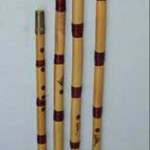
Ney (reed), probably the oldest pitched instrument known to man, is a wind instrument made from a piece of hollow cane or reed that has been played continuously for thousands of years. It is a forerunner of the modern flute and although common throughout the Near-east, the Iranian technique is probably the most versatile, using both the low breathy register and the sharp higher register (held between the teeth).
The pitch of the ney varies depending on the region and the finger arrangement. A highly skilled ney player can reach more than three octaves, though it is more common to have several “helper” neys to cover different pitch ranges or to facilitate playing technical passages.
Neys come in all sizes, in a range limited only by the reach of the fingers (for big neys) and the thickness of fingers (for small neys). Naturally, long neys are low pitched, and short neys are high pitched.
The Persian Ney is an oblique rim blown reed flute, held with both hands and with five finger holes in front and one thumb hole in the back. It is one of the principle instruments of Traditional Persian Music and has a range of two and a half octaves. The upper end is usually covered by a short brass cylinder which is anchored in the tiny space between the upper incisive of the player.
Sound is produced when a stream of air is directed by the tongue toward the opening of the instrument. In this way, sound is produced behind the upper teeth, inside the mouth, which gives the Iranian Ney a distinct sound.
Setar
Setar (meaning “three strings”), a fretted plucked-string instrument, with sharp overtone series, is a member of the lute family. Its ancestory can be traced to the ancient tanbur of pre-Islamic period. Clay statues found in Haft Tape and Choqa Zanbil ziggurat show musicians whose instrument is very similar to the present day setar. These images indicate the existence of an instrument called the tanbur from around 3 to 4 thousand years ago. Farabi, in his book, Musiqi al-Kabir, describes in detail the different kinds of the Iranian tanbur. These tanburs are very similar to the present setar and indicate that the present setar is the descendent of the old tanburs. Derivatives of setar are also played in Iraq, Pakistan and Afghanistan.
Two and a half centuries ago, a fourth string was added to the setar, which has 25 – 27 adjustable frets. Two of the strings are made of steel, two are of brass, and they are tuned to C, C semi-sharp, G, and C semi-sharp, respectively.
The sound range of the setar is two and half octaves and its sound volume is rather low. As a result, the setar used to be the instrument of the musician’s solitude. Because of its delicacy and intimate sonority, setar is the preferred instrument of Sufi mystics. Today, because of the advanced sound devices, the sound of the setar can be intensified. Therefore, it is played in the ensembles as well.
The average setar is 85 cm long, 20 cm wide, and has a 15 cm deep gourd, and is made entirely of thin mulberry wood; unlike the tar which has a membrane streched across the body. Also, unlike the tar, the player plucks the strings with the nail of the index finger, instead of using a plectrum.
Persian classical music does not consider as compulsory the use of Western music standardized pitch. This Standardization was established in 1939, and was mostly designed to cut through tuning problems in European music orchestration (which can use up to hundreds of instruments and choir).
Such a problem obviously doesn’t exist in Iranian music as ensembles historically have had a limited number of musician and singers. Moreover, in Persian music primacy goes to human natural voice which means that if there is a vocalist in the ensemble the instrumentalists have to tune according to his or her voice. Even when played solo it is tuned slightly lower than the Western standard C. There is no hard and fast rule attached to this. It is a matter of experience! Setar simply sounds better at the lower pitch.
There are two kinds of setar: one with a small sound box and the other with a larger sound box. The setar with a larger sound box is known as the Kamaliyan model, and the setar with small sound boxes are known as the Hashemi model. The main difference between the two models is the sound quality of each model. Those who prefer bass sound choose the Kamaliyan version, and those who like transparent and higher sound choose the Hashemi model.
Tar
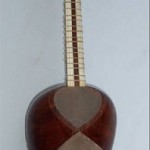
The tār (“string” in Persian) is a long-necked, waisted fretted plucked-string instrument. It has been adopted by other cultures and countries like Azerbaijan, Armenia, Georgia, and other areas near the Caucasus region. It is also the root of the names of the other Iranian instruments like setar, the guitar as well as less widespread instruments such as the Turkish dutar and the Indian sitar are also based on it.
The tar is one of the main instruments of the Persian art music and it is played both in ensemble and as a solo instrument. The sound volume of this instrument is comparable with those of the santur, ney oud, and kamanche and can be played without using a microphone.
The exact place of origin of the tar cannot be confirmed. However, it is certain that it existed in the territories of the Iranian Empire before Sassanids. Tar appeared in its present form in the Saffavid era although references to its distinct shape exist for a long period before.
The body is a double bowl shape carved from mulberry wood, with a thin membrane of stretched lamb-skin covering the top. The long fingerboard has twenty-six to twenty-eight adjustable gut frets, and there are three double courses of strings. Its range is about two and a half octaves, and is played with a small brass plectrum.
The melodies performed on tar were considered useful for headache, insomnia and melancholy, as well as for eliminating nervous and muscle spasms. Listening to this instrument was believed to induce a quiet and philosophical mood, compelling the listener to reflect upon life. Its solemn melodies were thought to cause a person to relax and fall asleep.
Tar is one of the most important Persian musical instruments. The general trends of Persian classical music have been deeply influenced by tar players. The most famous Iranian musicians in the past one hundred years have been the tar players.
Kamanche
The kamānche (“small bow”) is a bowed string instrument related to the bowed rebab, the historical ancestor of the kamancheh, and also to the bowed lira of the Byzantine Empire, ancestor of the European violin family. It is widely used in the classical music of Iran, Azarbaijan, Uzbakistan and Turkmenistan, with slight variations in the structure of the instrument. The Iranian instrument Ghyechak, the Russian Gudok and the Kazakh Kobyz are also related to kamanche.
In English the instrument is often known as the “spiked fiddle”, because of the spike protruding form its lower end, it is played vertically in the manner of the European cello though it is about the length of a viola. The end-pin can rest on the knee or thigh while seated in a chair.
It dates back to antiquity and like many other elements of Iranian music, entered Islamic music from the very beginning. The oldest written traces of the kamanche can be found in Farabi’s book, Musiqi al-Kabir. In this book, Farabi calls this instrument the rubab which has two strings. But, he also mentions the existence of a rubab with just one string. It has a small, hollowed hardwood body (originally coconut shell) with a thin stretched sheatfish or ox pericardium membrane (now ship skin). Its neck is cylindrical, and it has four metal strings (originally two and three-stringed variants exited). The strings are played with a variable-tension bow.
The instrument is highly ornate and is about the size of a viola. The modern version has four strings. Up to the beginning of the twentieth century, the kamānche had three strings. The kamancheh’s sound box is a spheroid chamber which is made from gourd or wood. In the older version, the spheroid chamber was heavier because it was carved from a single block of a wood. As a result, the sound quality was not as good as the ones made in the new method. The tuning varies depending upon the region of the country where it is being played. In Tehran, the kamanche is tuned in the same manner as a violin: G, D, A, E.
Santur
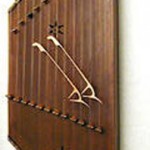
The santur is a struck zither in the form of a shallow, regular trapezoidal box. There are several sound posts inside the box, and two small rosettes on the top panel which help to amplify the sound. The santur has 72 strings, arranged in groups of four, i.e. each of four closely spaced strings are tuned to the same pitch. Each group of four strings is supported by a small, movable, wooden bridge; the bridges are positioned to give the instrument a range of three octaves. It is played with two small wooden hammers.
Santur can be made from various kinds of wood (walnut, rosewood, betel palm, etc.) connected by sound-posts whose position play an important role in the sound quality of the instrument. The secret of making the trapezoid shape sound box lies in the quality and age of the wood, as well as in the arrangement of the sound-posts which connect the table of the instrument to its back.
The Santur was invented probably around 1800 years ago and was traded and traveled to many different parts of the Middle East and each country customized and designed their own versions to adapt to their musical scales and tunings. The original Persian santur was made with tree bark, stones and stringed with goat intestines. The santur arrived in Europe during the Moorish occupation of Spain. Many instruments around the world at least in part, derive from the santur.
Similar forms of the santur have been present in neighboring cultures like India, Afghanistan, Pakistan, Armenia, Turkey, and Iraq for centuries. The Indian santur is thicker, more rectangular, and has more strings. The Chinese yangqin also originated from the Persian santur. The Iraqi santur has, since its inception, been chromatic and allows for full Magham modulations. The Romans introduced a derivative of the santur called the cymbalum to Eastern Europe. The Greek santouri is also derived from the Persian santur, and in Nikos Kazantzakis’ classic novel Zorba the Greek, Zorba plays the santouri.
Tonbak
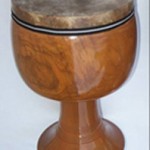
Tonbak or Tombak (or Zarb) is a single-headed chalice-shaped drum carved from solid mulberry wood about 43 cm in height with a 28 cm diameter head. It is covered at the wide end by a membrane of lamb or goat skin. The technique of this instrument uses both hands and consists of rolling and snapping the fingers in various ways. The rich variety of tones and textures on this instrument allows the player to punctuate and ornament the melodic phrases as well as create rhythmical patterns.
It is considered the principal percussion instrument of Persian music. The tombak is normally positioned diagonally across the torso while the player uses one or more fingers and/or the palm(s) of the hand(s) on the drumhead, often (for a ringing timbre) near the drumhead’s edge. ‘Tom’ and ‘bak’ are reference to the two basic strokes, one low (tom) in the center, and one high (bak) on the side of the membrane. Sometimes tonbak players wear metal finger rings for an extra-percussive “click” on the drum’s shell.
Tonbaks with adjustable tuning have been produced experimentally but the head tension is normally fixed prior to performance with careful attention to the temperature and humidity. The player may heat or cool or dampen or dry the membrane to reach a desired fundamental pitch.
Tanbur
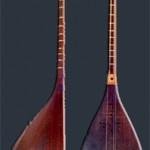
Tanbur is the ancestor to most long-necked, plucked stringed instruments. Its pear shaped belly is normally carved out of one piece of mulberry wood with a long neck and fourteen gut frets.
Some modern Tanburs are made of bent ribs of mulberry wood. The sound board, 3-4 millimeters thick, is also made of mulberry wood which has numerous small holes for better resonance. The tanbur’s body is a half-sphere up to 35 centimeters in diameter, constructed of staves glued together. The tied frets were originally made of twisted gut, but today, almost all tanbur players use frets of nylon monofilament. Modern tanburs generally have seven strings, but tanburs of the18th and 19th centuries had eight strings. In recent years, some players have had eight-string tanburs constructed.
Tanbur has a unique playing technique by which the strings are strummed with the fingers of the right hand to produce a very full and even tremolo. This technique along with various kinds of plucking, usually with the index and pinky fingers, enables the musician to produce different effects and various rhythmic accentuations which imitates the natural sounds of their environment such as a running stream, a water fall, a bird chirping or a horses’ gallop, all translated into musical rhythms and sounds.
The name “tanbūr” could have been derived from pandur, a Sumerian term for long-necked lutes. Lutes have been present in Mesopotamia since the third millennium BC. The Persian tanbur was already in use in the Sassanid period.
Daf
Daf is a type of frame drum that is depicted in many Persian miniatures and reliefs from centuries ago. The earliest evidence of the daf from the reliefs of Behistun dates back to Sassanid Iran. The Pahlavi (an ancient Iranic language) name of the daf is dap. The word daf is therefore the Arabicized form of the word dap. Daf is equipped with metal rings on the inside which add a jingle effect to the sound. The frame is covered with goat-skin.
Although it appears at first sight to be a relatively simple instrument, the Daf has the potential of producing intricate rhythmic patterns and sounds.
Frame drums are one of the oldest instruments on earth and were probably first used in the Middle East and Central Asia. It’s exactly in those regions that they’re still widespread and frequently used in all kinds of music from religious, trance to secular music.
Dayereh
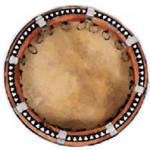
Dayereh (“circle”) is a medium-sized tambourine-like frame drum with jingles, used to accompany both popular and classical music in Iran. The simple drum is formed by attaching a skin cover onto a wooden ring with glue and cloth ties. This is similar to the Persian daf. The width of the frame is 45–50 cm and the depth, 5–7 cm.
It is found all over Asia and Eastern Europe. The history of dayereh goes back to many centuries. An engraved bronze cup from the pre-Islamic period at the National Museum of Iran, portrays a sorna, chang and dayereh in a shrine or a court procession.
The sound is produced by hitting the membrane with either hand – the left hand, which also holds the dayereh, strikes the edges, and the right hand strikes the center. The right-hand fingers are fastened about their neighbours and suddenly released (like the action of finger-snapping) to produce loud, rapid, sharp sounds.
Gheychak
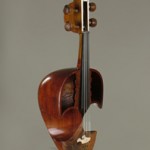
It is one of the ancient Iranian classical instruments. The oldest sample instrument still remaining is comprised of a dual box and the surface of the lower one is covered by a hide. The produced tune is first transferred from the lower box to the upper one, from where it is broadcast through two wide openings.
This part of the instrument is very interesting from the scientific point of view, since a second box has been added on its surface in order to amplify the tune. This makes the instrument much richer in producing a great variety of tunes. It has 4-6 cords, which similar to conventional Kamancheh, have been extended on a wooden box.
It is played by a bow of particular shape, while the musician simultaneously creates the desired tune by plucking the cords by his/her left hand. The instrument’s box is made of berry- or walnut wood.
Dohol
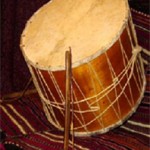
Dohol is a large double-skin drum. It varies in sizes. One side is made of goat skin, the other side is made of sheep skin. The thin skinned is hit with a light wooden stick or twig, and the thick side is hit with a heavy stick used to play bass sounds. The bigger stick is called “chogan” and the shorter one is called “tarkeh”. It is generally played outdoors accompanied by a Sorna.
The dohols played in southern Iran are cylindrical in shape and their two bases are covered by goat hide. Dohols commonly played in Fars province are different in form and quite similar to the western instrument known as timpani. Its body is metallic and made from copper, while its goat hide is fastened by leather band. The largest versions are played in Baluchestan.
Naghareh

Naghareh is also another popular drum, played in different regions of Iran. It is a combination of two drums and its size can vary from very small to huge ones that were tightened on elephant-backs in war fields in order to courage the troops. It is believed that the Indian tabla is based on naghareh. Generally Naghareh’s from the northern Iranian regions are smaller than the southern ones.
Their structure is like bowl. One is larger than the other. The large one is called Bam and the smaller one is called Zir (bass and treble). The drums are covered by cow’s skin, though in the past the skin of boar was used. The skin is tightened on the drums by band. The drums are played with two wooden drumsticks.
Introduction to Iranian History
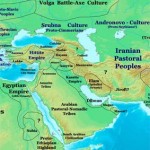
Iran as a country has been home to one of the world’s oldest continuous civilizations, with agricultural settlements dating back to the 6th millennium BC. The Iranian peoples are, however, a historical ethnic-linguistic group, consisting of the speakers of Iranian languages, a major branch of the Indo-European language family. Their historical areas of settlement were on the Iranian plateau, certain areas of Central Asia such as Tajikestan, most of Afghanistan, parts of Iraq, Turkey, Amenia, Pakistan and scattered parts of the Caucasus Mountains – a region that is sometimes termed the Iranian cultural continent.
The term Iran is derived from the Old Persian adjective Aryana (“the land of the Aryans”) which is itself a cognate of the Sanskrit word Arya. The original meaning of the term is not clear. It has been said the most likely translation is “the noble people” – based on the famous “Noble Eightfold Path” of Buddhism (āryā ṣṭāṅga mārga) which in turn is divided into three main groups closely resembling the three pillars of Zoroasterian belief in “Noble Thoughts, Noble Words, Noble Deeds”.
Although the term “Iran” has been used since ancient times to refer to both the country and its people, it was only in 1936 when it was adopted as the official name of the state. However, the academic usage of the term “Iranian People” or even the obviously restrictive term “Persian People” is distinct from the state of Iran. Many citizens of Iran are not necessarily Persian or Iranian people by virtue of not being either speakers of Iranian or Persian languages and may not have discernible ties to ancient Iranian tribes. Not to mention the fact that since the 1980s millions of Iranians have escaped the clerical autocracy in Iran and are now scattered all over the world.
In the following collection we have simply included all those dynasties, regardless of their ethnic origins, who have ruled parts or all of what is now called Iran. The collection should not be taken as the last word on anything but rather as a tool for finding your ways around the subject. We only hope the introductory texts that we have collected from existing sources and shortened to give you a general understanding of the subject do not discourage you from further research.
Elam, 3200–1100 BC
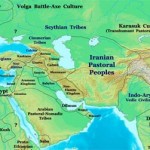
Elam was an ancient civilization located in what is now southwest Iran. The name is a transcription from Biblical Hebrew. In the Old Elamite period (Middle Bronze Age), Elam consisted of kingdoms on the Iranian plateau, centered in Anshan, and from the mid-2nd millennium BC, it was centered in Susa in the Khuzestan lowlands. Its culture played a crucial role in the development of later Persian dynasties, especially the Achaemenids.
At least three proto-Elamite states merged to form Elam: Anshan (modern Fars), Awan (probably modern Luristan), and Shimashki (modern Kerman). References to Awan are generally older than those to Anshan. Elamite sites are found well outside this area, spread out on the Iranian plateau; such as Warakshe, Sialk (now a suburb of the modern city of Kashan) and Jiroft (in Kerman Province). The state of Elam was formed from these lesser states as a response to invasion from Sumer during the Old Elamite period. Elamite strength was based on an ability to hold these various areas together under a coordinated government.
Knowledge of Elamite history remains largely fragmentary, reconstruction being based on mainly Mesopotamian sources. The history of Elam is conventionally divided into three periods, spanning more than two millennia. The period before the first Elamite period is known as the proto-Elamite period:
- Proto-Elamite: 3200 – 2700 BC (Proto-Elamite script in Susa)
- Old Elamite period: 2700 – 1500 BC (earliest documents until the Sukkalmah Dynasty)
- Middle Elamite period: 1500 – 1100 BC (Anzanite dynasty until the Babylonian invasion of Susa)
- Neo-Elamite period: 1100 – 540 BC (Assyrian and Median influence. 539 BC marks the beginning of the Achaemenid period.
The Elamites practised polytheism. Knowledge about their religion is scant, but in the later period, Elam worshipped a supreme triad consisting of Inshushinak (originally the civic protector god of Susa, eventually the leader of the triad and guarantor of the monarchy), Kiririsha (an earth/mother goddess in southern Elam), and Khumban (a sky god). Other deities include Pinikir (a mother goddess, and possibly originally chief deity, in northern Elam, later supplanted by or identified with Kiririsha) and Jabru (a god of the underworld[48]). There were also imported deities, such as Beltiya.
Elamite royalty in the final century preceding the Achaemenids was fragmented among different small kingdoms, the united Elamite nation having been destroyed and colonised by the Assyrians, but new polities emerged in the area after Assyrian power faded. Among the nations that benefited from the decline of the Assyrians were the Iranian tribes, whose presence around Lake Urmia to the north of Elam is attested from the 9th century BC in Assyrian texts. Sometime after that the region fell to Madius the Scythian (653 BC), and then Teispes, son of Achaemenes, conquered Elamite Anshan in the mid 7th century BC, forming a nucleus that would later expand into the Persian Empire. After the death of Ashurbanipal in 627 BC, the Medes played a major role in the destruction of the weakened Assyrian Empire in 612 BC.
Elamite is thought to be a language isolate, and completely unrelated to the neighbouring Semitic, Sumerian (also an isolate), and the later Indo-European Iranian languages that came to dominate the region. It was written in a cuneiform adapted from the Semitic Akkadian script of Assyria and Babylonia, although the very earliest documents were written in the quite different “Linear Elamite” script which some scholars believe had originally spread from further east to Susa. The Elamite language may have survived as late as the early Islamic period. Among other Islamic medieval historians, Ibn al-Nadim, for instance, wrote that “The Iranian languages are Fahlavi (Pahlavi), Dari (not to be confused with Dari Persian in modern Afghanistan), Khuzi, Persian and Suryani (Assyrian)”, and Ibn Moqaffa noted that Khuzi was the unofficial language of the royalty of Persia, “Khuz” being the corrupted name for Elam.
The Medes, 728–550 BC
The Medes were an ancient Iranian people who lived in Iran in an area known as Media and spoke a northwestern Iranian language referred to as the Median language. Their arrival in the region is associated with the first wave of Iranian tribes in the second millennium BCE. Historical references to their existence in Western Iran around lake Orumieh appear from 9th century BC.
The original source for their name and homeland is a directly transmitted Old Iranian geographical name which is attested as the Old Persian “Māda-” (singular masculine). The meaning of this word is not precisely known. However, linguist experts propose a relation with the proto-Indo European word “med(h)-“, meaning “central, suited in the middle”, by referring to the Old Indic “madhya-” and Old Iranian “maidiia-” which both carry the same meaning. The Latin medium, Greek méso and German mittel are similarly derived from it.
In the 7th century BC a unified Median state was formed which together with Babylonia, Lydia, and Egypt became one of the four major powers of the ancient Near East. An alliance with the Babylonians helped the Medes to capture Nineveh in 612 BC which resulted in the collapse of the Neo-Assyrian Empire. The Medes were subsequently able to establish their Median kingdom (with Ecbatana as their royal centre) beyond their original homeland. The Median kingdom was overtaken in 550 BC by the Achaemenid dynasty.
The discoveries of Median sites in Iran happened only after the 1960s. The search has mostly focused in an area known as the “Median triangle,” defined roughly as the region bounded by Hamadān and Malāyer (in Hamadan Province) and Kangāvar (in Kermanshah Province). Three major sites from central western Iran in the Iron Age III period (i.e. 850–500 BC) are:
• Tepe Nush-i Jan (a primarily religious site of Median period),
• Godin Tepe (its period II: a fortified palace of a Median king or tribal chief),
• Babajan (probably the seat of a lesser tribal ruler of Media).
Achaemenid Empire, 550–330 BC
The Achaemenid Empire was the successor state of the Median Empire, expanding to eventually rule over significant portions of the ancient world. At around 500 BC this empire stretched from the Indus Valley in the east, to Thrace and Macedon on the northeastern border of Greece and eventually controlling Egypt. It was unified by a complex network of roads and ruled by monarchs (shahs), to become one of the largest and greatest empires the world had yet seen. By the 5th century BC the Kings of Persia were either ruling over or had subordinated territories encompassing not just all of the Persian Plateau and all of the territories formerly held by the Assyrian Empire (Mesopotamia, the Levant, Cyprus and Egypt), but beyond this all of Anatolia and the Armenia, as well as the Southern Caucasus and parts of the North Caucasus, Azerbaijan, Uzbekistan, Tajikistan, all of Bulgaria, Paeonia, Thrace and Macedonia to the north and west, most of the Black Sea coastal regions, parts of Central Asia as far as the Aral Sea, the Oxus and Jaxartes to the north and north-east, the Hindu Kush and the western Indus basin (corresponding to modern Afghanistan and Pakistan) to the far east, parts of northern Arabia to the south, and parts of northern Libya to the south-west, and parts of Oman, China, and the UAE. In the 5th century BC, it is estimated that 50 million, or around 45% of the world population at that time lived in the Achaemenid Empire, which in terms of percentage of the world population would make it the largest empire in history.
The term Achaemenid is in fact the Latinized version of the Old Persian name Haxāmaniš (probably translating to “having a friendly mind”). Achaemenes was himself a minor 7th-century ruler of the Anshan (Ansham or Anšān) province located in southwestern Iran. It was not until the time of Cyrus the Great, a descendant of Achaemenes, that the Achaemenid Empire developed the prestige of an empire and set out to incorporate the existing empires of the ancient east.
The historical mark of the Achaemenid Empire went far beyond its territorial and military influences and included cultural, social, and religious influences as well. Many other countries adopted Achaemenid customs in their daily lives in a reciprocal cultural exchange. Cyrus founded the empire as a multi-state organisation, governed from four capital cities: Pasargadae, Babylon, Susa and Ecbatana. The Achaemenids allowed a certain amount of regional autonomy in the form of the satrapy system. A satrapy was an administrative unit, usually organized on a geographical basis. A ‘satrap’ (governor) was the governor who administered the region, a ‘general’ supervised military recruitment and ensured order, and a ‘state secretary’ kept the official records. The general and the state secretary reported directly to the satrap as well as the central government. At differing times in the empire, there were between 20 and 30 satrapies. Cyrus also created an organized army including the Immortals unit, consisting of 10,000 highly trained soldiers. Cyrus also formed an innovative postal system throughout the empire, based on several relay stations called Chapar Khaneh. The impact of Cyrus the Great’s Edict of Restoration is mentioned in Judeo-Christian texts and the empire was instrumental in spread of Persian cosmology as far east as China.
Religious toleration has been described as a “remarkable feature” of the Achaemenid Empire. The Old Testament reports that king Cyrus the Great released the Jews from their Babylonian captivity in 539–530 BC, and permitted them to return to their homeland. Cyrus assisted in the restoration of the sacred places of various cities. It was during the Achaemenid period that Zoroastrianism reached South-Western Iran, where it came to be accepted by the rulers and through them became a defining element of Persian culture. The religion was not only accompanied by a formalization of the concepts and divinities of the traditional Iranian pantheon but also introduced several novel ideas, including that of free will. Under the patronage of the Achaemenid kings, and by the 5th century BC as the de facto religion of the state, Zoroastrianism reached all corners of the empire.
Achaemenid architecture includes large cities, temples, palaces, and mausoleums such as the tomb of Cyrus the Great. The quintessential feature of Persian architecture was its eclectic nature with elements of Median, Assyrian, and Asiatic Greek all incorporated, yet maintaining a unique Persian identity seen in the finished products. Its influence pervades the regions ruled by the Achaemenids, from the Mediterranean shores to India, especially with its emphasis on monumental stone-cut design and gardens subdivided by water-courses. Achaemenid art includes frieze reliefs, metalwork such as the Oxus Treasure, decoration of palaces, glazed brick masonry, fine craftsmanship and gardening. Although the Persians took artists, with their styles and techniques, from all corners of their empire, they produced not simply a combination of styles, but a synthesis of a new unique Persian style.
The Acahemenids fell to the invading armies of Alexander III of Macedon. Alexander defeated the Persian armies at Granicus (334 BC), followed by Issus (333 BC), and lastly at Gaugamela (331 BC). Afterwards, he marched on Susa and Persepolis which surrendered in early 330 BC. Darius III was taken prisoner by Bessus, his Bactrian satrap and kinsman who then murdered Darius III and declared himself Darius’ successor. Alexander, put him on trial and ordered his execution. Alexander generally kept the original Achaemenid administrative structure, leading some scholars to dub him as “the last of the Achaemenids”. Upon Alexander’s death in 323 BC, his empire was divided among his generals, the Diadochi, resulting in a number of smaller states. The largest of these, which held sway over the Iranian plateau, was Seleucid Empire, ruled by Alexander’s general Seleucus I Nicator. Native Iranian rule would be restored by the Parthians of northeastern Iran over the course of the 2nd century BC.
Selucid Empire, 330–150 BC
The Seleucid Empire was created out of the eastern conquests of Alexander the Great. It was centred in the Near East and regions of the Asian part of the earlier Achaemenid Persian Empire. Seleucus I Nicator founded it, following the division of the Macedonian Empire. He received Babylonia (321 BC) and from there expanded his dominions to include much of Alexander’s near-eastern territories. At the height of its power, the Empire included central Anatolia, Persia, the Levant, Mesopotamia, and what is now Kuwait, Afghanistan, and parts of Pakistan and Turkmenistan.
The Seleucid Empire was a major centre of Hellenistic culture which maintained the preeminence of Greek customs and where Macedonian political elite dominated. Seleucid expansion into Greece itself was however abruptly halted after decisive defeats at the hands of the Roman army. By 100 BC, the once formidable Seleucid Empire encompassed little more than Antioch and some Syrian cities. Much of the Persian part of the empire was retaken by the Parthians, yet despite the clear collapse of their power, and the decline of their kingdom around them, nobles continued to play kingmakers on a regular basis, with occasional intervention from Ptolemaic Egypt and other outside powers. The Seleucid kings thus continued to rule a rump state from Syria until their ultimate overthrow by the Roman general Pompey. They existed solely because no other nation wished to absorb them – seeing them as a useful buffer between their other neighbours.
Greco-Bactrian Empire, 250–125 BC
The Greco-Bactrian Kingdom was the easternmost part of the Hellenistic world, covering Bactria and Sogdiana in Central Asia from 250 to 125 BC. The Greco-Bactrians were known for their high level of Hellenistic sophistication, and kept regular contact with both the Mediterranean and neighbouring India. They were on friendly terms with India and exchanged ambassadors.
Diodotus, the satrap of Bactria (and probably the surrounding provinces) founded the Greco-Bactrian Kingdom when he seceded from the Seleucid Empire and became King Diodotus I of Bactria. The preserved ancient sources (see below) are somewhat contradictory, and the exact date of Bactrian independence has not been settled. Euthydemus, a Greek from Magnesia and possibly satrap of Sogdiana, overthrew the dynasty of Diodotus I around 230-220 BC and started his own dynasty. Euthydemus’s control extended to Sogdiana, going beyond the city of Alexandria Eschate.
The Greco-Bactrian cities, such as Ai-Khanoum in northeastern Afghanistan and Bactra (modern Balkh) where Hellenistic remains have been found, demonstrate a sophisticated Hellenistic urban culture. Greek and Chinese influences on each other belong to this period. Some technology exchanges also occurred. The Greco-Bactrians used an alloy technology in the production of their coins only known by the Chinese at the time.
Some of the Greco-Bactrian coins, and those of their successors the Indo-Greeks, are considered the finest examples of Greek numismatic art. The largest coins to be minted in the Hellenistic world was minted by Eucratides (reigned 171–145 BC), the largest silver coin by the Indo-Greek king Amyntas Nikator (reigned c. 95–90 BC). The portraits “show a degree of individuality never matched by the often bland depictions of their royal contemporaries further West” (Roger Ling, “Greece and the Hellenistic World”).
Most parts of their empire were eventually taken over by the Parthians.
Parthian Empire, 248 BC–224 AD
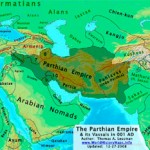
The Parthian Empire also known as the Arsacid Empire (Ashkāniān) was founded in the mid-3rd century BC by Arsaces I of Parthia, leader of the Parni tribe, when he conquered the Parthia region (roughly western Khorasan), then a satrapy (province) in rebellion against the Greek Seleucid Empire. Mithridates I of Parthia (171–138 BC) greatly expanded the empire by seizing Media and Mesopotamia from the Seleucids. At its height, the Parthian Empire stretched from the northern reaches of the Euphrates, in what is now Kurdistan, to eastern Iran. The empire, located on the Silk Road trade route between the Roman Empire in the Mediterranean Basin and the Han Dynasty in China, quickly became a center of trade and commerce.
The Parthians largely adopted the art, architecture, religious beliefs, and royal insignia of their culturally heterogeneous empire, which encompassed Persian, Hellenistic, and regional cultures. For about the first half of its existence, the Arsacid court adopted elements of Greek culture, though it eventually saw a gradual revival of Iranian traditions. The Arsacid rulers were titled the ‘King of Kings’, as a claim to be the heirs to the Achaemenid Empire. The Parthian era thus witnessed an Iranian cultural revival in religion, the arts, and even clothing fashions.
The earliest enemies of the Parthians were the Seleucids in the west and the Scythians in the north. However, as Parthia expanded westward, they came into conflict with the Kingdom of Armenia, and eventually the late Roman Republic. Rome and Parthia competed with each other to establish the kings of Armenia as their subordinate clients. The Parthians soundly defeated Marcus Licinius Crassus at the Battle of Carrhae in 53 BC, and in 40–39 BC, Parthian forces captured the whole of the Levant except Tyre from the Romans. However, Mark Antony led a counterattack against Parthia under the leadership of his lieutenant Ventidius. Various Roman emperors or their appointed generals invaded Mesopotamia in the course of the ensuing Roman–Parthian Wars of the next few centuries. The Romans captured the cities of Seleucia and Ctesiphon on multiple occasions during these conflicts, but were never able to hold on to them.
Frequent civil wars between Parthian contenders to the throne proved more dangerous to the Empire’s stability than foreign invasion, and Parthian power evaporated when Ardashir I, ruler of Istakhr in Persis, revolted against the Arsacids and killed their last ruler, Artabanus IV, in 224 AD. Ardashir established the Sasanian Empire, which ruled Iran and much of the Near East until the Muslim conquests of the 7th century AD.
Kushan Empire, 30–275
The Kushan Empire originally formed in the early 1st century AD under Kujula Kadphises in the territories of ancient Bactria on either side of the middle course of the Oxus River or Amu Darya in what is now northern Afghanistan, and southern Tajikistan and Uzbekistan.
The Kushan kings were a branch of the Yuezhi. Previously a nomadic people residing in the steppes northwest of China, they moved southwest and settled in northern Afghanistan. They had diplomatic contacts with Rome, Persia and Han China. While much philosophy, art, and science was created within its borders, the only textual record we have of the empire’s history today comes from inscriptions and accounts in other languages, particularly Chinese. The empire declined from the 3rd century and fell to the Sassanid and Gupta Empires.
The Kushans adopted elements of the Hellenistic culture of Bactria. They adopted the Greek alphabet to suit their own language (kharoshti). The Kushan religious pantheon is extremely varied, as revealed by their coins and their seals, on which more than 30 different gods appear, belonging to the Hellenistic, the Iranian (including deities of Mithraism), and to a lesser extent the Indian world. The Kushans are believed to have later become predominantly Zoroastrian. However, during the earlier period, Buddhism grew much faster in the area. Kanishka I, fifth Kushan king, is renowned in Buddhist tradition for having convened a great Buddhist council in Kashmir. Some later kings also gravitated towards Saivism (a sect of Hinduism).
The Kushan empire fragmented into semi-independent kingdoms in the 3rd century AD, which fell to the Sasanians invading from the west. The last of the Kushan and Kushano-Sasanian kingdoms were eventually overwhelmed by invaders from the north, known as the Kidarites.
Sasanid Empire, 224–651
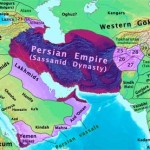
The Sasanid Empire, known to its inhabitants as Ērānshahr and Ērān, was the last pre-Islamic Persian Empire. The Sasanid Empire was recognized as one of the two main powers in Western Asia and Europe, alongside the Roman Empire and its successor, the Byzantine Empire, for a period of more than 400 years. The Empire was founded by Ardashir I, and lasted until Yazdegerd III lost control of his empire in a series of invasions from the Arab Caliphate.
During its existence, the Sasanid Empire encompassed all of today’s Iran, Afghanistan, Iraq, Syria, the Caucasus (Armenia, Georgia, Azerbaijan and Dagestan), southwestern Central Asia, part of Turkey, certain coastal parts of the Arabian Peninsula, the Persian Gulf area, and areas of southwestern Pakistan, stretching into India.
Officially, the Empire was known as the Empire of Iranians (Middle Persian: ērānšahr, Parthian: aryānšahr); the term is first attested in the Great Inscription of Shapur I, where the king says “I am the ruler of Empire of Iranians” Due to the fact that the ruling dynasty was named after Sasan, the Empire is known as the Sasanian Empire in historical and academic sources. Historians have also referred to the Sasanian Empire as the Neo-Persian Empire, since it was the second Iranian empire that rose from Pars while the Achaemenid Empire was the first one.
The Sasanian Empire is considered to have been one of Iran’s most important, and influential historical periods and constituted the last great Iranian empire before the Muslim conquest of Persia and the Islamization of Iran. In many ways, the Sasanian period witnessed the peak of ancient Iranian culture. The Sasanians’ cultural influence extended far beyond the empire’s territorial borders, reaching as far as Western Europe, Africa, China and India. It played a prominent role in the formation of both European and Asian medieval art. Much of what later became known as Islamic culture in art, architecture, music and other subject matter was transferred from the Sasanians throughout the Muslim world.
Surviving palaces illustrate the splendor in which the Sasanian monarchs lived. Examples include palaces at Firuzabad and Bishapur in Fars, and the capital city of Ctesiphon in the Asoristan province (present-day Iraq). Parthian architecture influenced Sasanian architectural practices characterized by the barrel-vaulted iwans. During the Sasanian period, these reached massive proportions, particularly at Ctesiphon. There, the arch of the great vaulted hall, attributed to the reign of Shapur I (241–272), has a span of more than 80 feet (24 m) and reaches a height of 118 feet (36 m). This magnificent structure fascinated architects in the centuries that followed and has been considered one of the most important examples of Persian architecture. Many of the palaces contain an inner audience hall consisting, as at Firuzabad, of a chamber surmounted by a dome. The Persians solved the problem of constructing a circular dome on a square building by employing squinches, or arches built across each corner of the square, thereby converting it into an octagon on which it is simple to place the dome. The dome chamber in the palace of Firuzabad is the earliest surviving example of the use of the squinch, suggesting that this architectural technique was probably invented in Persia.
Patriarchal Caliphate, 637–661
After Muhammad’s death in 632 CE, his Medinan companions debated which of them should succeed him in running the affairs of the Muslims while Muhammad’s household was busy with his burial. Umar and Abu Ubaidah ibn al-Jarrah pledged their loyalty to Abu Bakr, with the Ansar and the Quraysh soon following suit. Abu Bakr thus became the first Khalīfaṫu Rasūli l-Lāh (“Successor of the Messenger of God”), or Caliph, and embarked on campaigns to propagate Islam. First he would have to subdue the Arabian tribes which had claimed that although they pledged allegiance to Muhammad and accepted Islam, they owed nothing to Abu Bakr. Several companions, most prominent among them being Ali ibn Abi Talib, initially refused to acknowledge his authority. Ali may have been reasonably expected to assume leadership, being both cousin and son-in-law to Muhammad. Ali also had support among the Ansar for his succession. Abu Bakr sent Umar to confront Ali to gain his allegiance, resulting in an altercation which involved violence. However, after six months the group “made peace” with Abu Bakr and Ali offered him his fealty.
Once the internal rebellions had been put down, Abu Bakr began a war of conquest. Whether or not he intended a full-out imperial conquest is hard to say; he did, however, set in motion a historical trajectory that in just a few short decades would lead to one of the largest empires in history. Abu Bakr began with Iraq, the richest province of the Sasanian Empire. He sent general Khalid ibn Walid to invade the Sassanian Empire in 633. He thereafter also sent four armies to invade the Roman province of Syria.
The conquest of Persia led to the end of the Sassanid Empire in 644, the fall of Sassanid dynasty in 651 and the eventual decline of the Zoroastrian religion in Persia. Arabs first entered Sassanid territory in 633 in what is now Iraq. The Arabs eventually lost their holdings to Persian counterattacks. The second invasion began in 636, when a key victory at the Battle of Qadisiyyah led to the permanent end of Sassanid control of west of Persia. The Zagros mountains then became a natural barrier and border between the Rashidun Caliphate and the Sassanid Empire. Caliph Umar ordered a full invasion of the Sassanid Persian empire in 642, which was completed with the complete conquest of the Sassanids by mid 644.
Persia, on the verge of the Arab invasion, was a society in decline and decay and in many areas the over-taxed population embraced the invading Islamic army. Once politically conquered, the Persians, however, began to resist the Arabs culturally and maintained Persian, as opposed to Arabic culture. Regardless, Islam was adopted by many, either for political or socio-cultural reasons, and gradually became the dominant religion.
The Rashidun Caliphate is characterized by two decades of rapid military expansion, followed by a five-year period of internal strife and civil war. Muawiyah, the governor of the Levant during Uthman’s reign came out of the civil war as the victor and established the Umayyad Caliphate in 661.
Umayyad Caliphate, 661–750
The Umayyad Caliphate was the second of the four major Arab caliphates established after the death of Muhammad. It was ruled by the Umayyad dynasty, whose name derives from Umayya ibn Abd Shams, the great-grandfather of the first Umayyad caliph, Muawiya. Although the Umayyad family originally came from the city of Mecca, Damascus was the capital of their Caliphate.
At its greatest extent, it covered more than five million square miles (13,000,000 km2), making it one of the largest empires the world had yet seen, and the fifth largest contiguous empire ever to exist. The dynasty was eventually overthrown by a rebellion led by the Abbasids in 750. Survivors of the dynasty established themselves in Cordoba which, in the form of an Emirate and then a Caliphate, became a world centre of science, medicine, philosophy and invention, ushering in the period of the Golden Age of Islam.
The Hashimiyya movement (a sub-sect of the Kaysanites Shia), led by the Abbasid family, overthrew the Umayyad caliphate. The Abbasids were members of the Hashim clan, rivals of the Umayyads
Abbasid Caliphate, 750–1258
The Abbasid Caliphate was the third of the Islamic caliphates. It was founded in Harran in 750 but shifted its capital in 762 to Baghdad. It was ruled by a dynasty descended from Muhammad’s uncle, Abbas ibn Abdul-Muttalib (566–653 CE), from whom the dynasty takes its name. The Abbasid movement of opposition to Umayyads started in Persia during the reign of Umar II with Muhammad ibn ‘Ali, a great-grandson of Abbas, for the return of power to the family of Prophet Muhammad. During the reign of Marwan II, Abu Muslim, rising from Khorasan, successfully initiated an open revolt against Umayyad rule, which was carried out under the sign of the Black Standard. Close to 10,000 soldiers were under Abu Muslim’s command when the hostilities officially began in Merv in 747. 3 years later Abu al-‘Abbas as-Saffah, the fourth in descent from Abbas who finally defeated the Umayyads was subsequently proclaimed the new caliph. Marwan fled to Egypt, where he was subsequently assassinated. The Umayyad caliphs rule ended from all but the Al Andalus region.
The Abbasid caliphate was founded in Harran in 750 but shifted its capital in 762 to Baghdad. It flourished for two centuries, but slowly went into decline with the rise to power of the Turkick armies it had raised and created mainly to maintain control over the Persians and other non-Arabs (the Mamluks).
The Abbasid period was marked by reliance on Persian bureaucrats (notably the Barmakid family) for governing the territories as well as an increasing inclusion of non-Arab Muslims in the ummah (national community). Persianate customs were broadly adopted by the ruling elite, and they began patronage of artists and scholars. Baghdad became a centre of science, culture, philosophy and invention in what became known as the Golden Age of Islam.
Within 150 years of gaining control of Persia, the caliphs were thus forced to cede power to local dynastic emirs who only nominally acknowledged their authority. They were forced to cede authority over Morocco to the Idrisids in 788, Ifriqiya and Southern Italy to the Aghlabids in 800, Khorasan and Transoxiana to the Samanids and Persia to the Saffarids in the 870s, and Egypt to the Isma’ili-Shia caliphate of the Fatimids in 969. The political power of the caliphs was further limited with the rise of the Iranian Buyids and the Seljuq Turks, who captured Baghdad in 945 and 1055. Although Abbasid leadership over the vast Islamic empire was gradually reduced to a ceremonial religious function in much of the Caliphate, the dynasty retained control over its Mesopotamian domain. The Abbasids’ period ended in 1258 with the sack of Baghdad by the Mongols under Hulagu Khan and the execution of Al-Musta’sim.
Tahirid dynasty, 821–873
The Tahirid dynasty was an Iranian dynasty that ruled from 820 to 872 over the northeastern part of Greater Iran, in the region of Khorasan (parts that are presently in Iran, Afghanistan, Tajikistan, Turkmenistan, and Uzbekistan). The Tahirid capital was Merv and was then moved to Nishapur. The Tahirid dynasty is considered to be the first independent dynasty from the Abbasid caliphate established in Khorasan.
Although nominally subject to the Abbasid caliphate in Baghdad, the Tahirid rulers were effectively independent. The arrangement was really a partnership between the Abbasids and the Tahirids.” The tax revenue from Khorasan that was sent to the caliphal treasury was perhaps larger than those collected previously. The dynasty was founded by Tahir ibn Husayn, a leading general in the service of the Abbasid caliph al-Ma’mun. Tahir’s military victories were rewarded with the gift of lands in the east of Persia, which were subsequently extended by his successors as far as the borders of India.
The Tahirids were highly Arabized in culture and outlook, and eager to be accepted in the Caliphal. Tahirids were therefore not part of the renaissance of New Persian language and culture. The replacement of the Pahlavi script with the Arabic script in order to write the Persian language was in fact done by the Tahirids. The later Saffarids played a more important role in the renaissance of Persian literature.
Alavid dynasty, 864–928
The Alavids were a Shia emirate based in Mazandaran (Tabaristan) of Iran. They claimed to be the descendants of the second Shi’a Imam (Imam Hasan ibn Ali) and spread Shiite Islam in the region to the south of Caspian Sea. The later part of the Alavid rule was plagued by internal dissensions and power struggles. Their reign was ended when they were defeated by the Samanid dynasty in 928 AD. After their defeat some of the soldiers and generals of the Alavids joined the Samanid dynasty.
Mardavij the son of Ziar was one of the generals that joined the Samanids. He later founded the Ziyarid dynasty. Mardāvīj successfully defeated the Abbasid’s army firstly in Hamadan (in the midwest of Iran), and finally in Kashan and Isfahan (the central cities of the country).
On December 2, 931, Mardāvīj arrived in Isfahan, declared himself Amir of Iran and made Isfahan the capital of his Ziyarid kingdom. Ali, Hassan and Ahmad the sons of Buye (that were founders of the Buyid or Buwayhid dynasty) were also among generals of the Alavid dynasty who joined the Samanid army. Their capital was the city of Amol.
Saffarid dynasty, 861–1003
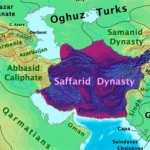
The Saffarid dynasty ruled in Sistan (861-1003), a historical region in southeastern Iran, southwestern Afghanistan and northwestern Pakistan. Their capital was Zaranj, located in present-day Afghanistan. The dynasty was founded by – and took its name from – Ya’qub bin Laith al-Saffar, a man of humble origins who rose from an obscure beginning as a coppersmith (ṣaffār) to become a warlord. He seized control of the Sistan region, conquering all of Afghanistan, modern-day eastern Iran, and parts of Pakistan.
Using their capital (Zaranj) as a base for an aggressive expansion eastwards and westwards, they overthrew the Tahirid dynasty and annexed Khorasan in 873. By the time of Ya’qub’s death, he had conquered Kabul Valley, Sindh, Tocharistan, Makran (Balochistan), Kerman, Fars, Khorasan, and nearly reached Baghdad but then suffered defeat. The Saffarid empire did not last long after Ya’qub’s death. His brother and successor Amr bin Laith was defeated in a battle against Ismail Samani in 900. Amr bin Laith was forced to surrender most of his territories to the new rulers. The Saffarids were subsequently confined to their heartland of Sistan, with their role reduced to that of vassals of the Samanids and their successors.
The Saffarids gave great importance to the Persian culture. Under their rule, the eastern Islamic world witnessed the emergence of prominent Persian poets such as Fayrouz Mashriqi, Abu Salik al-Jirjani, and Muhammad bin Wasif al-Sistani, who was a court poet. In the later 9th century, the Saffarids gave impetus to a renaissance of New Persian literature and culture. Following Ya’qub’s conquest of Herat, some poets chose to celebrate his victory in Arabic, whereupon Ya’qub requested his secretary, Muhammad bin Wasif al-Sistani, to compose those verses in Persian.
Samanid dynasty, 819–999
The Samanids were a Persian dynasty that reigned for 180 years, encompassing a territory which included Khorasan, Ray, Transoxiania, Tabaristan, Kerman, Gorgan, and west of these provinces up to Isfahan. The Samanid Empire was the first native Persian dynasty to arise after the Muslim Arab conquest. At the peak of their power, the Samanids controlled territory extending as far south as the Sulaiman Mountains, Ghazni and Kandahar.
The Samanids were descendants of Bahram Chobin, and thus descended from the House of Mihrān, one of the Seven Great Houses of Iran. It was named after its founder Saman Khuda, a Persian noble who belonged to a dehqan family. The Samanid state was founded by four brothers; Nuh, Ahmad, Yahya, and Ilyas —each of them ruled their own territory under Abbasid suzerainty. In 892, Ismail Samani (892–907) united the Samanid state under one ruler, thus effectively putting an end to the feudal system used by the Samanids. It was also under him that the Samanids became independent of Abbasid authority.
The Samanids promoted the arts, giving rise to the advancement of science and literature, and thus attracted scholars such as Rudaki, Ferdowsi, and Avicenna. While under Samanid control, Bukhara was a rival to Baghdad in its glory. The Samanids revived Persian language and culture more than the Buyids and the Saffarids, while continuing to patronize Arabic for sciences as well as religious studies. They considered themselves to be descendants of the Sasanian Empire.
Ziyarid dynasty, 928–1043
The Ziyarids were an Iranian dynasty that ruled in the Caspian sea provinces of Gorgan and Mazandaran from 928-1043 (also known as Tabarestan). The founder of the dynasty was Mardavij (from 927 to 935), who took advantage of a rebellion in the Samanid army of Iran to seize power in northern Iran. He soon expanded his domains and captured the cities of Hamadan and Isfahan.
Perhaps among the more interesting things from this era is that we know that Abu Rayhan Biruni, the great scientist of the Middle Ages, was supported by Qabus, the ruler of the Ziyarid state, in 1000 in his capital of Gorgan. In fact he dedicated his work to Qabus around 1000 and observed eclipses of the moon from there.
One of the most famous architectural works of Ziyarid dynasty is the Gonbad Kavous (Dome of Qabus”). The tomb is one of the earliest architectural monuments with a dated inscription surviving in post-Islamic Iran. The tomb, built of fired brick, is an enormous cylinder capped by a conical roof. The circular plan, broken by 10 flanges, is 17 m in diameter. The height from base to tip is 49 m. Legend has it, that the body of Qabus was enclosed in a glass coffin which was suspended by chains from the interior dome inside the tower.
Buyid dynasty, 934–1055
The Buyid dynastywere a Shī‘ah Persian dynasty that originated from Daylaman in Gilan. They founded a confederation that controlled most of modern-day Iran and Iraq in the 10th and 11th centuries. The Deylamites were an Iranian people inhabiting the mountainous regions of northern Iran on the southern shore of the Caspian Sea. Many of them were employed as soldiers from the time of the Sassanid Empire, and they are known for having long resisted the Arab conquest of Iran and its subsequent Islamization.
The founders of the Būyid confederation were Alī ibn Būyah and his two younger brothers, al-Hassan and Aḥmad. Originally a soldier in the service of the Ziyārīds of Ṭabaristān, Alī was able to recruit an army to defeat a Turkish general from Baghdad named Yāqūt in 934. Over the next nine years the three brothers gained control of the remainder of the Abbāsid Caliphate. While they accepted the titular authority of the caliph in Baghdad, the Būyid rulers assumed effective control of the state. In 945, Ahmad entered Iraq and made the Abbasid Caliph his vassal, at the same receiving the laqab Mu’izz ad-Dawla (“Fortifier of the State”), while ‘Ali was given the laqab Imād al-Dawla (“Support of the State”), and Hasan was given the laqab Rukn al-Dawla (“Pillar of the State”).
The Buyids established a confederation in Iraq and western Iran. This confederation formed three principalities – one in Fars, with Shiraz as its capital – the second one in Jibal, with Ray as its capital – and the last one in Iraq, with Baghdad as its capital. However, during their late period, more principalities formed in the Buyid confederation. Succession of power was hereditary, with fathers dividing their land among their sons. The title used by the Buyid rulers was amir, meaning “governor” or “prince”. Generally, one of the amirs would be recognized as having seniority over the others; this individual would use the title of amir al-umara, or senior amir. Some of the stronger amirs used the Sassanid title of Shahanshah. Furthermore, several other titles such as malik (“king”), and malik al-muluk (“king of kings”), were also used by the Buyids.
During the mid-11th century, the Buyid amirates gradually fell to the Ghaznavid and Seljuq Turks. In 1029, Majd al-Dawla, who was facing an uprising by his Dailami troops in Ray, requested assistance from Mahmud of Ghazna. When Sultan Mahmud arrived, he deposed Majd al-Dawla, replaced him with a Ghaznavid governor and ended the Buyid dynasty in Ray. In 1055, Tughrul conquered Baghdad, the seat of the caliphate, and ousted the last of the Buyid rulers. Like the Buyids, the Seljuqs kept the Abbasid caliphate as the titular ruler.
Ghaznavid Empire, 975–1187
The Ghaznavids were a Persianate Muslim dynasty of Turkic slave origin which existed from 975 to 1187 and ruled much of Persia, Transoxania, and the northern parts of the Indian subcontinent. The Ghaznavid state was centered in Ghazni, a city in present Afghanistan. Due to the political and cultural influence of their predecessors – that of the Persian Samanid Empire – the originally Turkic Ghaznavids had become thoroughly Persianized. In terms of cultural championship and the support of Persian poets, they were far more Persian than the ethnically Iranian Buyids rivals, whose support of Arabic letters in preference to Persian is well known.
Persian literary culture enjoyed a renaissance under the Ghaznavids during the 11th century. The Ghaznavid court was so renowned for its support of Persian literature that the poet Farrukhi traveled from his home province to work for them. Manuchehri, also was active at that time and wrote numerous poems to the merits and advantages of drinking wine. Sultan Mahmud, modelling the Samanid Bukhara as a cultural center, made Ghazni into a center of learning, inviting Ferdowsi and al-Biruni. He even attempted to persuade Avicenna, but was refused. Mahmud preferred that his fame and glory be publicized in Persian and hundreds of poets assembled at his court. He brought whole libraries from Rey and Isfahan to Ghazni and even demanded that the Khwarizmshah court send its men of learning to Ghazni.
The dynasty was founded by Sebuktigin upon his succession to rule of territories centered around the city of Ghazni from his father-in-law, Alp Tigin, a break-away ex-general of the Samanid sultans. Sebuktigin’s son, Shah Mahmoud, expanded the empire in the region that stretched from the Oxus river to the Indus Valley and the Indian Ocean; and in the west it reached Rey and Hamadan. Under the reign of Mas’ud I it experienced major territorial losses. It lost its western territories to the Seljuqs resulting in a restriction of its holdings to what is now Afghanistan, as well as Balochistan and the Punjab. In 1151, Sultan Bahram Shah lost Ghazni to Ala’uddin Hussain of Ghor and the capital was moved to Lahore until its subsequent capture by the Ghurids in 1186.
Seljuk Empire, 1037–1194
The Seljuq Empire was a medieval Turko-Persian Sunni Muslim empire, originating from the Qynyq branch of Oghuz Turks. The Seljuq Empire controlled a vast area stretching from the Hindu Kush to eastern Anatolia and from Central Asia to the Persian Gulf. From their homelands near the Aral sea, the Seljuqs advanced first into Khorasan and then into mainland Persia before eventually conquering eastern Anatolia.
The Seljuq empire was founded by Tuğrul Beg in 1037 after the efforts by the founder of the Seljuq dynasty, Seljuq Beg, back in the first quarter of the eleventh century. Seljuq Beg gave his name both to the state and the dynasty. The Seljuqs united the fractured political scene of the Eastern Islamic world and played a key role in the first and second crusades. The Seljuq rule was modelled after the tribal organization common in Turkic and Mongol nomads and resembled a ‘family federation’ or ‘appanage state’. Under this organization, the leading member of the paramount family assigned family members portions of his domains as autonomous appanages.
Highly Persianized in culture and language, the Seljuqs also played an important role in the development of the Turko-Persian tradition, even exporting Persian culture to Anatolia. The Seljuqs founded universities and were also patrons of art and literature. Their reign is characterized by Persian astronomers such as Omar Khayyám, and the Persian philosopher al-Ghazali. Under the Seljuqs, New Persian became the language for historical recording, while the center of Arabic language culture shifted from Baghdad to Cairo.
The last ruler of Seljuqs , Togrul III was the Sultan of all Seljuq except for Anatolia. In 1194, his army was defeated by Takash, the Shah of Khwarezmid Empire, and the Seljuq Empire finally collapsed. As the dynasty declined in the middle of the thirteenth century, the Mongols invaded Anatolia in the 1260s and divided it into small emirates called the Anatolian beyliks. Eventually one of these, the Ottoman, would rise to power and conquer the rest.
Ghurid dynasty, 1149–1212
The Ghurids were a medieval Muslim dynasty of Iranian origin that ruled during the 12th and 13th centuries in Khorasan. At its zenith, their empire, that was centered in Ghōr (now a province in Afghanistan), stretched over an area that included the whole of modern Afghanistan, the eastern parts of Iran and the northern section of the Indian subcontinent, as far as Delhi. The Ghurids were succeeded in Persia by the Khwārazm-Shāh dynasty and in North India by the Mamluk dynasty of the Delhi Sultanate.
The origins of the dynasty are obscure. According to legend, the Shansabānī family (founders of the dynasty) had ancestral lines to the Sassanian royal family who – led by Pirōz II – fled with some hundred thousand of followers from Western Iran to Khorasan, following the Arabic conquest of Persia. There is evidence of such a migration but the ancestral claims cannot be verified. The dynasty was most likely of Tajik origin. It should be noted that the actual name of the Ghurid family, Āl-e Šansab (Persianized: Šansabānī), is the Arabic pronunciation of the originally Middle Persian name Wišnasp. It has also been claimed, but not proven, that the inhabitants of Ghor were still Zoroastrians, isolated from all Arab-Islamic influence until the 11th century when they were eventually converted to Islam by the Samanid and Ghaznavids.
The Ghurids were great patrons of Persian culture and literature and lay the basis for a Persianized state in India. However, most of the literature produced during the Ghurid era has been lost. They also transferred Iranian architecture to India. Out of the Ghurid state grew the Delhi Sultanate which established the Persian language as the official court language of the region – a status it retained until the late Mughal era in the 19th century.
Khwarezmid dynasty, 1077–1231
The Khwarezmian dynasty was a Persianate Sunni Muslim dynasty of Turkic mamluk origin. They ruled Greater Iran in the High Middle Ages, in the period of about 1077 to 1231, first as vassals of the Seljuqs and later as independent rulers, up until the Mongol invasions of the 13th century. The dynasty was founded by Anush Tigin Gharchai, a former slave of the Seljuq sultans, who was appointed the governor of Khwarezm. His son, Qutb ud-Dīn Muhammad I, became the first hereditary Shah of Khwarezm.
In 1218, Genghis Khan sent a trade mission to the state, but at the town of Otrar the governor, suspecting the Khan’s ambassadors to be spies, confiscated their goods and executed them. Genghis Khan demanded reparations, which the Shah refused to pay. Genghis retaliated with a force of 200,000 men, launching a multi-pronged invasion. In February 1220 the Mongolian army crossed the Syr Darya, beginning the Mongol invasion of Central Asia. The Mongols stormed Bukhara, Samarkand, and the Khwarezmid capital Urgench. The Shah fled and died some weeks later on an island in the Caspian Sea.
Though the Mongols had destroyed the Khwarezmian Empire in 1220, many Khwarezmians survived by working as mercenaries in northern Iraq. Sultan Jalal ad-Din’s followers remained loyal to him even after his death in 1231, and raided the Seljuk lands of Jazira and Syria for the next several years, calling themselves the Khwarezmiyya. Ayyubid Sultan as-Salih Ayyub, in Egypt, later hired their services against his uncle as-Salih Ismail. The Khwarezmiyya, heading south from Iraq towards Egypt, invaded Crusader-held Jerusalem along the way, on 11 July 1244. The city’s citadel, the Tower of David, surrendered on August 23, and the Christian population of the city was expelled. This triggered a call from Europe for the Seventh Crusade, but the Crusaders would never again be successful in retaking Jerusalem. After being conquered by the Khwarezmian forces, the city stayed under Muslim control until 1917, when it was taken from the Ottomans by the British. After taking Jerusalem, the Khwarezmian forces continued south, and on October 17 fought on the side of the Ayyubids at the Battle of La Forbie, as the Crusaders used to call Harbiyah, a village northeast of Gaza, destroying the remains of the Crusader army there, with some 1,200 knights killed. It was the largest battle involving the Crusaders since the Battle of the Horns of Hattin in 1187. The remains of the Muslim Khwarezmians served in Egypt as Mamluk mercenaries until they were finally beaten by al-Mansur Ibrahim some years later. Khwarizmi war captives assimilated into the Mongols, forming the modern Mongolian clan Sartuul.
Ilkhanate, 1256–1353
The Ilkhanate was a Mongol khanate established in Persia in the 13th century, considered a part of the Mongol Empire. The Ilkhanate was based, originally, on Genghis Khan’s campaigns in the Khwarezmid Empire in 1219–1224, and founded by Genghis’s grandson, Hulagu, in what territories which today comprise most of Iran, Iraq, Afghanistan, Turkmenistan, Armenia, Azerbaijan, Georgia, Turkey, and some regions of western Pakistan. The Ilkhanate initially embraced many religions, but was particularly sympathetic to Buddhism and Christianity. Later Ilkhanate rulers, beginning with Ghazan in 1295, embraced Islam.
Hulagu Khan, grandson of Genghis Khan and brother of both Möngke Khan and Kublai Khan. He was charged with subduing the Muslim kingdoms to the west “as far as the borders of Egypt.” Hulagu brought with him many Chinese scholars and astronomers and with the help of the famous Persian astronomer Nasir al-Din al-Tusi built an observatory in Maragheh using Chinese calculating tables. The Chinese science of astronomy was considered to be more advanced than the Islamic one.
The Ilkhanate started crumbling under the reign of Gaykhatu. The majority of Mongols had converted to Islam while the Mongol court remained Buddhist. Gaykhatu had to buy the support of his followers and as a result, ruined the realm’s finances. His vizir Sadr-ud-Din Zanjani tried to bolster the state finances by adopting paper money which ended horribly. Gaykhatu also alienated the Mongol old guard with his alleged sexual relation. Gaykhatu was overthrown in 1295 and replaced with his cousin Baydu. Baydu reigned for less than a year before he was overthrown by Gaykhatu’s son, Ghazan. Hulagu’s descendants ruled Persia for the next eighty years, tolerating multiple religions, including Shamanism, Buddhism, and Christianity, and ultimately adopting Islam as a state religion in 1295.
The courts of Western Europe made many attempts to form an alliance with the Mongols, primarily with the Ilkhanate, in the 13th and 14th centuries, starting from around the time of the Seventh Crusade United in their opposition to the Mamluks in Syria, the Ilkhanate and the Europeans were nevertheless unable to satisfactorily combine their forces against their common enemy. The Ilkhanate Mongols remained nomadic in their way of life until the end of the dynasty. Their nomadic routes covered central Iraq, northwest Iran, Azerbaijan, and Armenia. The Mongols administered Iraq, the Caucasus, and western and southern Iran directly with the exception of Georgia, the Artuqid sultan of Mardin, and Kufa and Luristan. The Qara’unas Mongols ruled Khorasan as an autonomous realm and did not pay taxes. Herat’s local Kart dynasty also remained autonomous. Anatolia was the richest province of the Ilkhanate, supplying a quarter of its revenue while Iraq and Diyarbakir together supplied about 35 percent of its revenue.
The Ilkhanate had an important historical impact in the Middle Eastern region. The establishment of the unified Mongol Empire had significantly eased trade and commerce across Asia. The Ilkhanate also helped to pave the way for the later Safavid dynastic state, and ultimately the modern country of Iran. Hulagu’s conquests had also opened Iran to Chinese influence from the east. This, combined with patronage from his successors, would develop Iran’s distinctive excellence in architecture. Under the Ilkhans, Iranian historians also moved from writing in Arabic to writing in their native Persian tongue. The rudiments of double-entry accounting were practiced in the Ilkhanate; merdiban was then adopted by the Ottoman Empire. These developments were independent from the accounting practices used in Europe.
Kartids dynasty, 1231–1389
The Kartid Dynasty was a Persian dynasty that ruled over a large part of Khorassan during the 13th and 14th centuries. Ruling from their capital at Herat (Afghanistan) and central Khorasan in the Bamyan-Valley, they were at first subordinates within the Ilkhanate, and upon the fragmentation of the Ilkhanate in 1335 they became de facto independent rulers up until the invasion of Timur in 1381.
The Karts trace their lineage to a Tajuddin Uthman Marghini, whose brother, ‘Izzuddin Umar Marghini, was the Vizier of Sultan Ghiyāṣ-ud-din Muhammad bin Sām (1202-3). The founder of the Kart dynasty was Malik Rukn-ud-din Abu Bakr, who was descended from the Shansabani family of Ghur. His son Shamsu’d-Din was given authority over Herat, Jam, Ghor, Khaysar, Firuz-Kuh, Gharjistan, Farah, Sistan, Kabul, Tirah, and Afghanistan (the Sulaiman Mountains) all the way to the Indus River by the Ilkhan ruler.
The karts did nor rule long. They became the victims of Timur’s first Persian campaign and the remaining karts were murdered by Miran Shah the son of Timur in 1396.
Muzaffarid dynasty, 1314–1393
The Muzaffarids were a Sunni family that came to power in Iran following the breakup of the Ilkhanate in the 14th century. The Muzaffarids originated as an Arab family that settled in Khorasan from the beginning of Caliphate rule. They stayed in Khorasan up until the Mongol invasion, at which point they fled to Yazd. Serving under the Il-Khans, they gained prominence when Sharaf al-Din Muzaffar was made governor of Maibud. His son, Mubariz ad-Din Muhammad, was brought up at the Il-Khan’s court. In around 1319 he overthrew the atabeg of Yazd and was subsequently recognized as governor of the city by the central Il-Khan government. In the wake of the loss of Il-Khan authority in central Iran, Mubariz ad-Din carried out his expansionary policy. In 1339 or 1340 he invaded the province of Kirman and seized it from its Mongol governor. The city of Bam was besieged and conquered a few years after this. They soon became the strongest power in central Iran, and Shiraz was made their capital.
Their last ruler Shah Shoja before dying in 1384, named his son Zain al-Abidin his successor and his third brother ‘Imad ad-Din Ahmad as governor of Kirman. On his deathbed, Shah Shoja wrote a letter to Timur, who was then campaigning in Azerbaijan, in which he gave his sons’ loyalty to the conqueror. When Zain Al-Abidin succeeded his father, he quickly ignored the declaration of loyalty. Timur, therefore, marched into the Muzaffarid lands.
Sarbadars state, 1337–1381
The Sarbadars (“head on gallows”) were a mixture of religious dervishes and secular rulers that came to rule (1337) over part of western Khorasan in the midst of the disintegration of the Mogul Ilkhanate in the mid-14th century. Centred in their capital of Sabzevar, they continued their reign until they submitted to Teymur in 1381, and were one of the few groups that managed to mostly avoid Teymur’s famous brutality.
Its rulers were Shi’ite, and followers of Sheykh Khalifa; a scholar from Mazandaran, who had arrived in Khurasan some years before the founding of the Sarbadar state and was subsequently murdered by Sunnis. His successor, Hasan Juri, established the former’s practices in the Sarbadar state. The followers of these practices were known as “Sabzavaris” after the city. As the Sarbadars conquered the neighbouring territory, they also acquired cities with significant Sunni populations.
The Sarbadars are unique among the major contenders in post-Ilkhanid Persia in that none of their leaders ruled as legitimate sovereigns. None of them had a legitimate claim to the Ilkhanid throne or was related to a Mongol or any other royal house, and none of them had previously held a high post within the Ilkhanate. While they on occasion recognized claimants to the Ilkhanid throne as their overlord, they did so purely as a matter of convenience, and in all other aspects, they had no ties to the Ilkhanate. This fact had a strong influence regarding the nature of the Sarbadar political state.The Sarbadars had a form of government which would, in modern times, probably be identified as an oligarchy or a republic. Unlike their neighbours, the Sarbadars had no dynastic lines; power usually went to the most ambitious.
The Sarbadar state came into existence around early 1337. At that time, much of Khurasan was under the control of the Ilkhanid claimant Togha Temur. They made peace with Togha Temur, promising to recognize him as sovereign and to pay taxes to him. The khan agreed, in the hope that it would put a stop to the Sarbadar raids on his supply trains. Following the death of Timur, the Sarbadars slowly fell out of prominence.
Chupanid dynasty, 1337–1357
The Chupanids were descendants of a Mongol family of the Suldus clan that came to prominence in 14th century Persia. At first serving under the Ilkhans, they took de facto control of the territory after the fall of the Ilkhanate. The Chupanids made Azerbaijan their stronghold, while the Jalayirids took control in Baghdad.
The early Chupanids were members of the Soldus tribe. Sorgan Sira, one of the first important Chupanids, served Genghis Khan during the latter’s rise to power. Later on, the Chupanids came to live under the authority of the Ilkhanate. A descendent of Sorgan Sira, Amir Tudahun, was killed in 1277 fighting against the Mamluks at the battle of Eblistan. He left a son, Malek, who in turn fathered Amir Chupan, the namesake of the Chupanids.
The Chobanid attempted to capture Baghdad from the Jalayirids in 1347 but failed miserably. The forces of the Golden Horde overran the Chobanid realm and captured Tabriz in 1357. Malek Asraf their ruler was executed, and his family brought north to the Golden Horde. Malek Asraf’s offspring was eventually killed off in Persia, bringing a definitive end to the Chobanids as a power.
Timurid Empire, 1370–1506
The Timurids were a Persianate, Central Asian Sunni Muslim dynasty of originally Turko-Mongol descent whose empire included the whole of Central Asia, Iran, modern Afghanistan, as well as large parts of contemporary Pakistan, North India, Mesopotamia, Anatolia and the Caucasus. It was founded by the militant conqueror Timur (Tamerlane) in the 14th century.
In the 16th century, Timurid prince Babur, the ruler of Ferghana, invaded North India and founded the Mughal Empire, which ruled most of the North India until its decline in the early 18th century, and was formally dissolved by the British Raj after the Indian rebellion of 1857. Later princes of the dynasty predominantly used the title Mirza to show descent from the Amir.
The Timurids embraced Persian culture, converted to Islam, and resided in Turkestan and Khorasan. Thus, the Timurid era had a dual character, reflecting both its Turco-Mongol origins and the Persian literary, artistic, and courtly high culture of the dynasty. Persian was the primary language of administration and literary culture. Thus the language of the settled “diwan” was Persian, and its scribes had to be thoroughly adept in Persian culture, whatever their ethnic origin. Persian became the official state language of the Timurid Empire and served as the language of administration, history, belles lettres, and poetry. The Chaghatay language was the native and “home language” of the Timurid family.
Aq Qoyunlu, 1378–1508
The Ak Koyunlu or Aq Qoyunlu, also called the White Sheep Turkomans was an Oghuz Turkic tribal federation that ruled parts of present-day Eastern Turkey, Armenia, Azerbaijan, northern Iraq, and Iran from 1378 to 1508.
Ak Koyunlu Turkomans first acquired land in 1402, when Tamerlane granted them all of Diyarbakır, in present-day Turkey. For a long time, the Ak Koyunlu were unable to expand their territory, as the rival Kara Koyunlu kept them at bay. However, this changed with the rule of Uzun Hassan who defeated the Black Sheep Turkoman leader, Jahān Shāh, in 1467. Uzun Hasan was able to take Baghdad along with territories around the Persian Gulf. He expanded into Iran as far east as Khorasan. However, around this time, the Ottoman Empire sought to expand eastwards, a serious threat that forced the Aq Qoyunlu into an alliance with the Karamanids of central Anatolia.
Following Ya’qub’s death, who reigned from 1478 to 1490, civil war again erupted, the Aq Qoyunlus destroyed themselves from within, and they ceased to be a threat to their neighbours.
Qara Qoyunlu, 1407–1468
The Kara Koyunlu or Qara Qoyunlu, also called the Black Sheep Turkomans were a Shi’ite Oghuz Turkic tribal federation that ruled over the territory comprising the present-day Armenia, Azerbaijan, north-western Iran, eastern Turkey and Iraq from about 1375 to 1468.
The Kara Koyunlu Turkomans at one point established their capital in Herat in eastern Persia, and were vassals of the Jalayirid dynasty in Baghdad and Tabriz from about 1375, when the leader of their leading tribe, ruled over Mosul. However, they rebelled against the Jalayirids, and secured their independence from the dynasty with the conquest of Tabriz by Qara Yusuf.
In 1400, Timur defeated the Kara Koyunlu, and Qara Yusuf fled to Egypt, seeking refuge with the Mamluk Sultanate. He gathered an army and by 1406 had taken back Tabriz. In 1410, the Kara Koyunlu captured Baghdad. The installation of a subsidiary Kara Koyunlu line there hastened the downfall of the Jalairids they had once served. Kara Koyunlu later broke up due to internal fighting among Qara Yusuf’s descendants after his death in 1420, and the increasing threat of the Armenian revolts.
Safavid Empire, 1501–1722
The Safavid dynasty was one of the most significant ruling dynasties of Iran. They ruled one of the greatest Persian empires since the Muslim conquest of Persia and established the Twelver school of Shi’a Islam as the official religion of their empire, marking one of the most important turning points in Muslim history. The Safavids were the main architect of the current spread of shiism in the whole region.
The Safavids ruled from 1501 to 1722 and at their height, they controlled all of modern Iran, the current Republic of Azerbaijan and Republic of Armenia, most of Iraq, Georgia and Afghanistan, as well as parts of Pakistan, Turkmenistan and Turkey. Safavid Iran, along with its neighbours, the Ottoman and Mughal empires, was one of the “gunpowder empires”,
The Safavid dynasty had its origin in the Safaviyya Sufi order, which was established in the city of Ardabil in the Azerbaijan region. It was of mixed ancestry (Kurdish and Azerbaijani, which included intermarriages with Georgians and Greeks). The bulk of the Safaviyya were nomadic Oghuz Turkic-speaking clans from Asia Minor and Azerbaijan and were known as Qizilbash (“Red Heads”) because of their distinct red headgear. The Qizilbash were warriors, spiritual followers and a source of the Safavid military and political power. From their base in Ardabil, the Safavids established control over all of Greater Iran and in 1501 Shāh Ismāil I founded the Safavid dynasty.
Despite their demise in 1736, the legacy that they left behind was the revival of Iran as an economic stronghold between East and West, the establishment of an efficient centralised state with a professional bureaucracy based upon “checks and balances”. Their architectural innovations and their patronage of the arts has also left its lasting marks on Iran.
Hotaki dynasty, 1722–1729
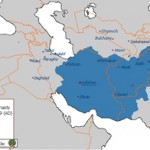
The Hotakis were a Pashtun tribe and dynasty that ruled parts of the Persian Empire from 1722 to 1729, after defeating and replacing the Safavid dynasty. The dynasty was founded in 1709 by Mirwais Hotak, chief of the Ghilzai Pashtuns of Kandahar who successfully revolted against the Safavids rule in Kandahar. After his death in 1715, the monarchy passed on to his brother followed by his sons and nephew until the dynasty finally ended in 1738 when Nader Shah and his Afsharids defeated Hussain Hotaki at Kandahar. At its peak, the Hotak dynasty ruled briefly over an area which is now Afghanistan, Iran, western Pakistan, and some parts of Tajikistan and Turkmenistan.
Kandahar province had been captured and ruled by the Shi’a Safavids during the early 18th century but the native Afghan tribes living in the area were Sunni Muslims. Immediately to the east began the Sunni Moghul Empire of India, that occasionally fought wars with the Safavids over the territory of Kandahar. In April of 1709, Mirwais along with his followers revolted against the Safavid rule in Kandahar City and defeated a Persian army that was dispatched from Isfahan. Mirwais died in 1715 and his son Mahmud’s Afghan forces crossed the deserts of Sistan and captured Kerman in 1720. After defeating the Persian army at the Battle of Gulnabad on March 8, 1722, he proceeded to and besieged Isfahan for 6 months, after which it fell. On October 23, 1722, Sultan Husayn abdicated and acknowledged Mahmud as the new Shah of Persia.
The Hotak dynasty was a troubled and violent one from the very start as internecine conflict made it difficult to establish permanent rule. The dynasty lived under great turmoil due to bloody succession feuds and after the massacre of thousands of civilians in Isfahan – including more than three thousand religious scholars, nobles, and members of the Safavid family – the Hotak dynasty was eventually removed from power in Persia.
Afsharid dynasty, 1736–1750
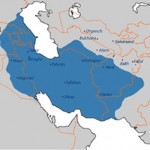
The Afsharids were of Turkmen origin from Khorasan who ruled Persia in the 18th century. The dynasty was founded in 1736 by the military commander Nader Shah who decisively defeated the Hotaks in 1729 and then deposed his main ally in that fight, the last member of the Safavid dynasty and few years later proclaimed himself King of Iran. During Nader’s reign, Iran reached its greatest extent since the Sassanid Empire. Under Nader Shah, Persia regained lost territories from the Ottomans, Afgans, and Russians. Military campaigns into India also brought back treasures such as the famous Peacock Throne and Koh-i-Nor diamond.
Nader initiated a new religious policy aimed at reconciling Shia with Sunni Islam. The Safavid dynasty had relied heavily on the support of Shi’ites, but many soldiers in Nader’s army were Sunnis. Nader also wanted to set himself up as a rival of the Ottoman sultan for supremacy within the Muslim world, which would have been impossible had he remained an orthodox Shi’ite.
In 1738, Nader Shah conquered Kandahar, the last outpost of the Hotaki dynasty and established Naderabad, Kandahar. His thoughts now turned to the Mughal Empire based in Delhi. Nader asked for the Afghan rebels to be handed over, but the Mughal emperor refused. Nader used this as a pretext to cross the border and invade the militarily weak but still extremely wealthy far eastern empire. He captured Ghazni, Kabul, Peshawar, Sindh and Lahore. By 1739 he had defeated the Mughal army, captured Mohammad Shah and entered Delhi. When the The Persian troops left Delhi Nader ceded back to Muhammad Shah all territories to the east of the Indus that he had overrun. Nader’s soldiers also took with them thousands of elephants, horses and camels, loaded with the booty they had collected. The plunder seized from India was so valuable that Nader stopped taxation in Iran for a period of three years following his return.
With the wealth he gained, Nader started to build a Persian navy. With lumber from Mazandaran, he built ships in Bushehr. He also purchased thirty ships in India. He recaptured the island of Bahrain from the Arabs. In 1743, he conquered Oman and its main capital Muscat. In 1743, Nader started another war against the Ottoman Empire. Despite having a huge army at his disposal, in this campaign Nader showed little of his former military brilliance. It ended in 1746 with the signing of a peace treaty, in which the Ottomans agreed to let Nader occupy Najaf.
After Nader’s death in 1747 the rule of the Afsharid did not last long and by 1760 they were thoroughly defeated by the Qajars.
Zand Dynasty, 1750–1794
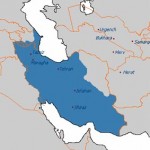
The Zand dynasty ruled southern and central Iran in the 18th century. The dynasty was founded by Karim Khan, chief of the Zand tribe which was from Northern Luristan. He became one of Nader Shah’s generals. Nader Shah moved the Zand tribe from their home in lakestan to the eastern steppes of Khorasan. After Nader’s death, the Zand tribe, under the guidance of Karim Khan, went back to their original land. Karim Khan and his soldiers defected from the army and in 1760, founded his own dynasty. Karim Khan declared Shiraz his capital. He gained control of central and southern parts of Iran. He refused to accept the title of the king and instead named himself “The Advocate of the People” (Vakilol Ro’aya).
Karim Khan’s monuments in Shiraz include the famous Arg of Karim Khan, Vakil Bazaar, and several mosques and gardens. He is also responsible for building of a palace in the town of Tehran, the future capital of the Qajar dynasty. Karim Khan’s death in 1779 left his territory vulnerable to threats from his enemies. Soon enough, the country was under attack from all sides. The biggest enemies of the Zands, the Qajar chiefs, led by Agha Mohammad Khan, eventually defeated Lotf Ali Khan, a grand-nephew of Karim Khan putting an effective end to the Zand Dynasty.
The Zand era was an era of relative peace and economic growth for the country. Many territories that were once captured by the Ottomans in the late Safavid era were retaken, and Iran was once again a coherent and prosperous country. Iranian painting reached its height at the end of the 17th century, and a special school of painting took shape during the Zand era in the 17th and 18th centuries. The art of this era is remarkable and, despite the short length of the dynasty, a distinct Zand art had the time to emerge. Many Qajar artistic traits were copied from the Zand examples.
In foreign policy, Karim Khan attempted to revive the Safavid era trade by allowing the British to establish a trading post in the port of Bushehr. This opened the hands of the British East India company in Iran and increased their influence in the country. The taxation system was reorganized in a way that taxes were levied fairly. The judicial system was considered to be fair and generally humane. Capital punishment was rarely implemented.
Qajar Dynasty, 1794–1925
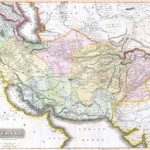
The Qajar family took control of Iran in 1794, deposing Lotf Ali Khan Zand and re-asserted Persian sovereignty over parts of the Caucasus. In 1796 Agha Mohammad Khan Qajar was formally crowned as shah. He established his capital at Tehran, a village near the ruins of the ancient city of Rayy. A year later he was assassinated and was succeeded by his nephew, Fath Ali Shah Qajar. Overall, the Qajar period is one of major retrograde steps for Iran. It is in this crucial stage in the development of the world economy that Iran failed to modernise its economy and state and undertake the necessary reforms.
The Qajar rulers were decendents of Turkmen peoples. Qajars first settled during the Mogul period in the vicinity of Armenia and were among the seven Qizilbash tribes that supported the Safavids. The Safavids left Arran (the greater Azerbaijan) to local Turkic speaking khans. Qajars were one such tribe governing parts of southern Arran. The Qajar armies were composed of Turkoman bodyguards and Georgian slave soldiers.
During the Qajar period Iran lost some of its territory in Afghanistan (to the British), North Azerbaijan (to Russia) and Kurdistan (to the Ottomans). The Iranian Constitutional Revolution of 1906 which limited the absolute power of the Shah and established an elected parliament was defeated with the help of the Russian Kossack army supporting Mohammad Ali Shah Qajar. The Qajar dynasty was eventually overthrown by a British backed coup in 1921 which led t the establishment of Pahlavi Dynasty in 1925.
Pahlavi Dynasty, 1925–1979
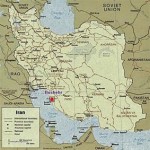
In February 1921, Reza Khan, an officer in the Persian Cossack Brigade (which came under British command after the Russian Revolution of 1917), used his troops to support a British backed coup against Ahmad Shah Qajar. In 1923, Ahmad Shah was forced into exile in Europe and in October 1925 Reza Khan induced the Majles to depose the Ghajar dynasty and proclaim him as the new Shah. He ruled for the next 16 years with absolute power. Reza Shah had ambitious plans for modernizing Iran. These plans included developing large-scale industries, implementing major infrastructure projects, building a cross-country railroad system, establishing a national public education system, reforming the judiciary, and improving health care. He believed only a strong, centralized dictatorship managed by loyal personnel could carry out his plans.
Following Germany’s invasion of the Soviet Union in June 1941, Britain and the USSR saw the newly-opened Trans-Iranian Railway as an attractive route to transport supplies from the Persian Gulf to the Soviet Union. In August 1941, under the pretext of alleged Reza Shah’s support for Germany, Britain and the Soviet Union invaded Iran, arrested the Shah and sent him into exile in South Africa. Following the collapse of Reza Shah’s regime the occupying powers allowed his son, Mohammad Reza Pahlavi to accede to the throne.
In the context of regional turmoil and the Cold War, Mohammad Reza Shah established himself as an indispensable ally of the USA. Domestically, he advocated reform policies, culminating in the 1963 program known as the White Revolution, which included land reform, extension of voting rights to women, and the elimination of illiteracy, whilst banning all freedom of expression and establishing a single-party rule. His autocratic regime became more and more unpopular and his government collapsed following widespread uprisings in 1978 and 1979. He left the country in January 1979.
The Islamic Republic, 1979-
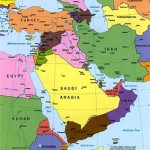
In February 1979, following a poular uprising which led to the collapse of the Bakhtiar government (appointed by the Shah before he left the country), a new government headed by Mehdi Bazargan came to power with the backing of the army, security services and a clandestine committee set up by Ayattollah Khomeini representing a coallition of shiite hierarchy and the bazar. The new government organised a referendum seeking poular approval of the as yet undefined “Islamic Republic”! Having obtained its “majority” it then disfranchised the population by electing an assembly of “Islamic experts” to write up a constitution for the Islamic Republic, which despite claiming to be a republic is in effect a theocracy giving absolute power to an unelected cleric appointed by clerics. Currently all the basic democratic rights are denied to the Iranian population.
Millions of Iranians have been forced into exile and Iranian art and culture has been pushed back centuries. Corruption and nepotism in government is endemic and the supporters of the regime have turned Iran into a merchants haven where most internal production is sacrificed for the benfit of the merchants and hoarders. The current levels of poverty and unemployment in Iran has not been seen for a hundred years.
Barbat
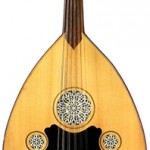
Barbat is a shortneck fretless lute with five double-courses of strings tuned in fourths and traditionally played with an eagle’s quill. Many instruments such as the Arabic oud are derived from the barbat. Today’s barbat, however, is essentially the same thing as today’s oud. It is often called the barbat when played in a Persian tradition, while called the oud when played in an Arabic tradition.
Persian Barbat is the ancestor of the European lute, and the current oud and functions as a bass instrument in traditional Persian music. It originated in Persia in ancient times, and was refined during the Islamic age into its current form. Zaryab (9th AD), is said to have improved the Barbat by adding a fifth pair of strings, and using an eagle’s beak or quill instead of a wooden pick.
After the tanbur, it is the oldest string instrument in Iran. Historical evidence shows that around the 8th century BC a kind of barbat was used. In some books the invention of this instrument is ascribed to Barbod, the famous musician of the Sassanid era. Indeed, the reason this instrument is called Barbat is that this name is the Arabic form of Barbod, as they associated this instrument with him. But although Barbod was a famous player of barbat he was not its inventor.
The barbat is held similar to a guitar, but care must be taken to have the face vertical so that it is not visible to the player, and to support the weight with the thigh and right arm so that the left hand is free to move around the fingerboard. In all matters of holding and playing it is recommended that the player use only the muscles needed for any musical task and to relax as much as possible, using only as much force as is necessary. This will allow one to play longer, easier and to put the effort into creativity rather than mechanics. In the past many players sat cross-legged on a rug, but now most perform sitting, often using a classical guitarist’s footrest under the right foot to help hold the barbat.
Chang

Chang is an Iranian harp. It was very popular and used widely in ancient Persia, especially during the Sassanid Dynasty where it was often played in the royal court. Since the 17th century it has not been widely used.
The Sassanid Chang was based on the vertical, angular harp which had been developed in the Hellenistic world. The Persian design made them lighter.
These angular harps were themselves based on the more ancient mesopotamian lyre (or hand-held harps) which had been around since the 3rd Millennium BC. Archaelogical evidence from Susa (Shush) contain depictions of Persian angular harps that differ consistently from those in Mesopotamia: while their shapes are similar, the Persian harps are smaller in size.
In the contemporary Iranian musical culture, the chang is not a regular instrument and is not a member of any ensembles. However, some Iranian instrument makers have been trying to revive the chang based on the existing cameos and writings of the past.
Rabab
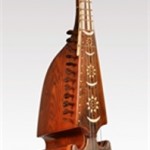
Robab (or Rubab and not to be confused with Rebab) is a short-necked lute made of wood, with goatskin covering the body. It is a plucked instrument with 12 to 18 strings. Only six of the strings are for playing; the rest being drone strings. It is played by a pick made of an animal horn or sometimes plastic and has a soft and bass sound.
The Robab is attested from the 7th century CE. It is mentioned in old Persian books, and many Sufi poets mention it in their poems. It is the traditional instrument of Khorasan and today it is widely used in countries such as Afghanistan, Pakistan, Iran, Tajikistan, India and Uzbekistan. In Iran it is mostly considered as a local instrument of the Sistan and Baluchistan province although it is being increasingly used in musical ensembles.
It is however very popular in Afghanistan. It is known as “the lion of instruments” and is one of the two national instruments of Afghanistan. Classical Afghan music often features this instrument as a key component. Elsewhere it is known as the Kabuli Rubab. It is the ancestor of the Sarod but unlike the sarod it is a fretted instrument.
Robab is made from the trunk of a mulberry tree. Originally the strings were made from the intestines of young goats, brought to the size of thread. But, today some strings are made of plastic as well. The melody strings were originally five, but now they are six. In fact, each two melody strings are tuned the same; therefore, there are three pairs of strings which are tuned in fourths. The drone strings are tuned the same.
Professor Colm O’Muircheartaigh

Professor O’Muircheartaigh is dean of the Harris School of the University of Chicago and a senior fellow in the National Opinion Research Center (NORC). He is the principal investigator on the National Science Foundation’s (NSF) Internet Panel Recruitment Survey. He is also responsible for the development of methodological innovations in sample design for NORC’s face-to-face surveys in the U.S.
He has served as a consultant to a wide range of public and commercial organizations in the United States, the United Kingdom, Ireland, Italy, and the Netherlands. Through his work with the United Nations, OECD, the Commission of the European Communities, the International Association for Educational Assessment, and others, Professor O’Muircheartaigh has also worked in China, Myan Mar, Kenya, Lesotho, and Peru.